Walk-in Shower Installation in South London
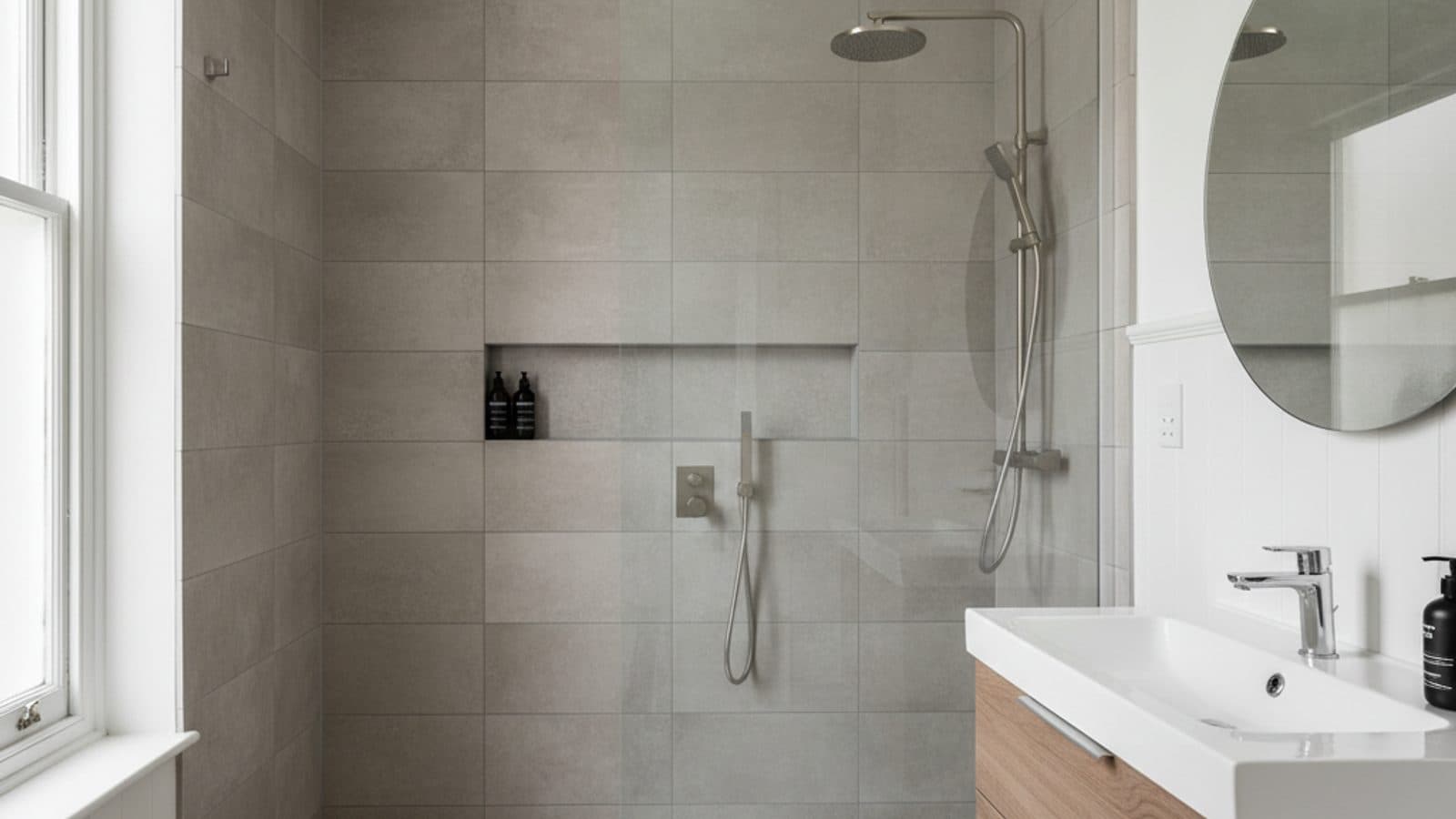
Walk-in showers built with frameless glass, a low-profile tray or level access, recessed tiled niches and proper tanking behind every tile.
All Well Property Services provides professional walk-in shower installation across South East London. I price every project individually after a free site visit, so you get a clear written quote with a week-by-week programme rather than a calculator estimate. All projects include a fixed-price contract, single project manager, and full Building Control sign-off. Call 020 3920 9617 for a free consultation.
What We Offer
Walk-in showers built with frameless glass, a low-profile tray or level access, recessed tiled niches and proper tanking behind every tile. Across South London since 2020.
- ✓Frameless toughened glass screens, fixed panel or hinged door
- ✓Low-profile stone-resin trays set flush into the floor
- ✓Level-access formed floors with a hidden linear drain
- ✓Recessed tiled niches built into the wall before tiling
- ✓Thermostatic bar and concealed valves with a fixed rain head and handset
- ✓Linear and point drainage sized to the showerhead flow
- ✓Full tanking behind the tiles in every wet zone
- ✓Large-format wall tiling with sealed, mitred edges
- ✓Solid backing fixed for screens and grab rails before tiling
How I price walk-in showers
I quote every job after a free site visit. The price covers materials, labour and a realistic programme, all fixed in writing before we start. No hidden costs, no mid-job surprises.
Book a free site visitWhat Affects the Cost?
- •Tray type chosen, either a low-profile stone-resin tray or a formed, tiled level-access floor
- •Glass screen specification, from a standard toughened panel to a frameless 10mm screen with a slim profile
- •Whether the existing floor can take the fall to a level-access drain without raising the room
- •Waterproofing required, from board-and-tape tanking on a standard tray to a full tanked floor for level access
- •Valve and outlet specification, from a single thermostatic bar valve to a recessed valve with a separate rain head and handset
- •Tiling complexity, including recessed niches, mitred corners and large-format walls
Walk-in shower installation across South London
If you are searching for walk-in shower installation in South London, this is work my team does most weeks. A walk-in is the build people picture when they want their bathroom opened up, with glass in place of a curtain and a flush floor in place of a step. The look is simple. Getting it right is not. Since 2020 I have fitted walk-in showers across the SE and SW postcodes, on solid floors and on the suspended timber floors common in our older terraces, and I am on site for the tanking and the falls, not just the quote. The parts that decide whether a walk-in lasts all sit behind the tiles, where you never see them.
Low-profile trays and level-access floors
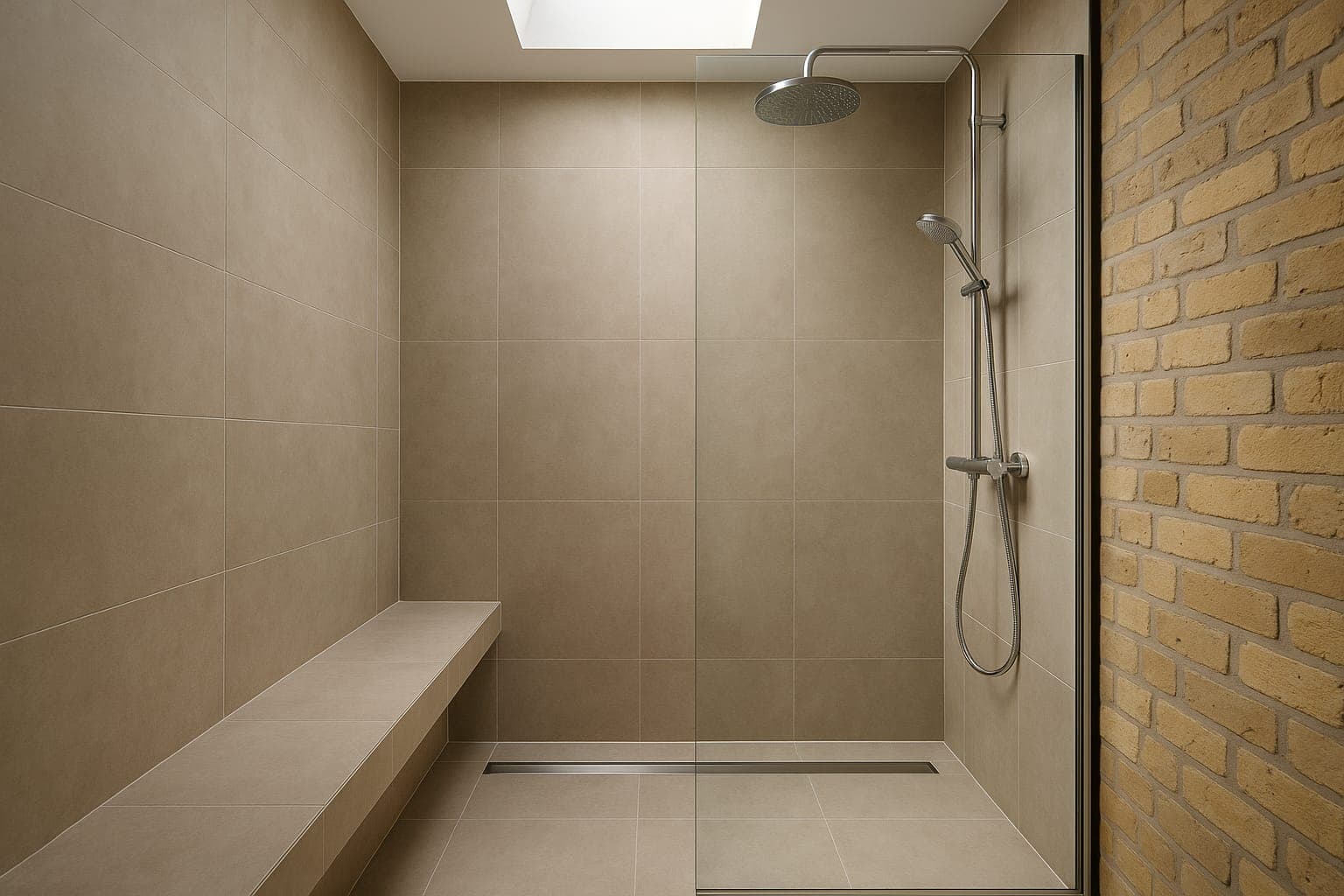
Walk-in shower installation usually comes down to one early decision, a low-profile tray or a level-access floor. A low-profile stone-resin tray sits almost flush with the finished floor and gives a near step-free entry with far less disruption, because the drainage sits within the tray rather than under the room. A level-access floor removes the step. We form the fall in the floor itself, drop a linear or point drain below the boards, then tank and tile across it so the shower runs straight off the bathroom floor. Level access looks the cleanest and suits anyone who wants step-free use, but it needs the floor depth to take the drain, which is why I check the joists before committing to it.
Frameless glass screens
A frameless glass screen is what makes a walk-in shower feel open rather than boxed in. We use 8mm or 10mm toughened glass with a slim wall profile and no surrounding frame, so the eye runs straight through to the tiling behind. The screen has to be fixed into something solid, so before tiling we set timber noggins or a backing board into the wall where the bracket lands, rather than relying on a plug in plasterboard. A heavy glass panel screwed into a hollow wall works loose within a year. We also set the screen past the line of the spray, so the water that bounces off the wall has somewhere to fall other than the bathroom floor.
Recessed tiled niches and tiling
A recessed tiled niche is the storage that belongs in a walk-in shower, built into the wall cavity rather than stuck on with a wire basket. We frame and waterproof the niche before tiling, fall the bottom shelf slightly forward so water drains out instead of sitting, and tile it to line through with the wall courses around it. On large-format wall tiles we plan the layout so the niche, the valve and the screen all land on sensible joints, because a niche cut through the middle of a tile looks like an afterthought. The internal niche corners get the same sealing tape as the rest of the wet zone, since a niche is a hole cut into your waterproofing and has to be sealed back up.
Valves, drainage and how we deliver the work
A walk-in either runs water away as fast as it arrives and holds a steady temperature, or it does neither and you notice every day. The plumbing and the drainage are where that is decided, and both go in before the tiling so they end up inside the wall and under the floor where they belong.
Thermostatic valves and showerheads
We fit a thermostatic valve as standard, either a surface bar valve or a concealed valve buried in the wall feeding a fixed rain head and a separate handset. The thermostatic cartridge holds the temperature when someone runs a tap or flushes elsewhere in the house, so the shower does not scald or run cold part way through a wash. A concealed valve gives the cleanest look, with only the controls and the outlets on show, but it has to be set at the right depth in the wall before tiling and pressure-tested while the wall is still open. We match the valve to your water pressure, because a low-pressure gravity system and a rain head are a poor pairing without a pump, and I would rather say that at the survey than after the tiles are on.
Drainage and the falls
Drainage is the part most walk-in failures trace back to. The floor or tray has to fall to the drain at the right gradient, and the drain has to clear water as fast as the head delivers it. We size the waste and set the fall to the showerhead flow rather than guessing, and on level-access floors we favour a linear drain along a wall, which lets the floor fall in one direction and reads cleaner than a square gully in the middle. The drain trap has to stay accessible for cleaning, so we set it where it can be lifted without disturbing the tiling. A walk-in that pools water around the feet has the wrong fall or an undersized waste, and that is a design fault, not something you live with.
How we run the job
We strip out the old enclosure, set the tray or form the level-access fall, run the valve and waste, then tank the wet zone and let it cure before tiling. After the tiling we fit the screen, the valve trims and the head, seal the junctions with sanitary silicone over the tanked corners, and test it under running water before handover. One project manager owns the job from strip-out to the last bead of silicone, with the scope agreed in writing after a free site visit. Most walk-in installations take one to two weeks, depending on the floor and the tiling.
Standards, sign-off and credentials
Every walk-in we install is tanked and tested to the standard that applies to it, and the electrics for any shower pump, extractor or underfloor heating are signed off under Part P. All Well Property Services operates from Unit 1 Limes Avenue, Anerley, London SE20 8QR. All Well Property Services is Gas Safe registered. All Well Property Services holds NICEIC approved, FENSA and CHAS accreditation. All Well Property Services carries Public Liability insurance to 5 million pounds. All Well Property Services is registered at Companies House under number 12721034, with 57 verified Google reviews averaging 4.9 out of 5 stars.
Free tools for planning your project
No email required. Get instant estimates and planning answers before you book a consultation.
Best Month
See historic rainfall and temperature for your postcode every month, plus the best window for external work. Live data from the Open-Meteo archive (Met Office and ECMWF).
Listed Check
Check whether your property is a listed building or sits inside a conservation area, and what that means for renovation work. Live data from Planning.data.gov.uk and Historic England.
Planning Risk
Traffic-light check of every planning restriction at your postcode: listed buildings, conservation areas, Article 4 directions, Tree Preservation Orders, flood zones. Live data from Planning.data.gov.uk.
EPC Upgrade
Find your home's current EPC rating and see what it would cost to upgrade to a B. Uses live data from the EPC Open Data register.
Recent Walk-in Showers Projects
Walk-in Shower Installation across South East London
What Our Customers Say
“So happy with the work done by Les and Richard!! We bought a house that needed new paint, cracks filled, a new bathroom fan and some mold removal and they did it all. The quality of the work is phenomenal; it looks like a brand new house. We’ll definitely be hiring them for our future projects!”

Brenna Bodine
6 months ago
“We've had a media wall put in place with fireplace. Richard was very professional and everything that I had got addressed fast. The medial wall looks great, would def recommend them”

Raluca Andra
a month ago
“A totally outstanding experience from Richard and his team. Les did an absolutely amazing job of turning around the much needed re decoration of my apartment at the end of a long tenancy, pulling out all the stops to deliver a first class job on a tight timeframe. The Electrician assigned also turned things around quickly and again to a high standard. Extremely professional and I don’t hesitate to recommend or use again in the future.”

Charlie Watson
2 months ago
Accredited & Certified
Frequently Asked Questions
- What is the difference between a walk-in shower and a full wet room?
- A walk-in shower keeps the showering zone contained. It uses a tray, either a low-profile stone-resin one set into the floor or a formed level-access floor, with a glass screen that holds the splash inside a defined area. The rest of the bathroom floor stays dry and is often finished in a different material. A full wet room takes the waterproofing across the whole room, so the entire floor falls to the drain and there is usually no screen or only a single splash panel. Both need tanking, but a wet room tanks the complete floor and the lower walls, while a walk-in mainly tanks the shower zone. In most South London bathrooms I fit a walk-in rather than a full wet room, because it gives the open feel people want without committing the whole room to a single fall, and it suits the timber suspended floors common in Victorian and Edwardian houses.
- Can I have a level-access walk-in shower on a suspended timber floor?
- Often yes, but it depends on the joists and the floor build-up. A level-access shower needs the drain and the fall set below the finished floor, so on a suspended timber floor we cut into the joist zone to drop a former and a linear drain, then board and tank over it. Where the joists run the wrong way or there is not enough depth, we either set the drain across the joist line or build the floor up slightly at the doorway to gain the fall. On a solid concrete floor it is more straightforward, because the screed can be cut and re-laid to the drain. I check the floor at the site visit before promising level access, because a level-access tray that cannot reach a proper fall will pool water, and a shower that pools is a shower that leaks. A low-profile tray is the reliable alternative where the structure will not allow a fully recessed drain.
- How do you stop a walk-in shower leaking behind the tiles?
- Tiles and grout are not waterproof. Water passes through grout joints over time, so the waterproofing sits behind the tile, not in it. We tank the wet zone with a tanking system, either a liquid membrane or waterproof boards with taped and sealed joints, taking it up the walls and across the floor or tray upstand. Internal corners, the floor-to-wall junction and the pipe penetrations all get a sealing tape or collar, because those are the points that fail first. The tanking is left to cure before any tile goes on. Done this way, the membrane carries any water that gets through the grout straight back to the drain rather than into the wall or the ceiling below. This matters most on the party walls and timber floors in older South London homes, where a slow leak can run for months before it shows.
- What size does a walk-in shower need to be?
- A comfortable walk-in starts at around 900mm wide, and 1000 to 1200mm gives room to move without water escaping past the screen. The depth from the wall to the screen wants to be at least 800mm so the spray stays off the opening, and a longer run lets you set a fixed panel without a door at all. In a tighter en-suite we still fit walk-ins down to 800mm by using a single fixed screen and placing the showerhead to throw water away from the entry. The screen position and the drain location matter as much as the raw size, because a well-placed linear drain along the back wall and a screen set past the spray will keep a small shower dry. At the site visit I measure the room and the soil pipe run, then lay out the largest workable showering zone for the space you have.
- Do I need building regulations approval for a walk-in shower?
- You will not need planning permission for a walk-in shower inside an existing bathroom, but parts of the work sit under the building regulations. Any new or altered electrics in the bathroom, such as a shower pump, an extractor fan or underfloor heating, fall under Part P and have to be installed and signed off by a qualified electrician. New waste pipework and ventilation are covered too, and the room needs adequate extraction to deal with the moisture a walk-in throws out. If we move the soil connection or alter the drainage, that work has to meet the standards as well. I handle the parts that need sign-off as part of the job, so the electrical certificate and the relevant notices are dealt with rather than left for you to chase. On a like-for-like swap inside the same room the regulatory side stays light, and I will tell you at the survey which parts apply to your bathroom.
Related Services
Get a Free Walk-in Showers Quote
Free site visit. No-obligation quote. We respond within 24 hours — usually the same day.
Book Free Consultation