Fire risk assessment requirements: Quick Guide to UK Fire Safety Compliance
When it comes to fire risk assessment requirements in the UK, the rule is pretty simple: if you’re in charge of a property that isn’t a private home, you need to carry out a proper assessment to find and fix any fire hazards. This isn't just a box-ticking exercise; it's a vital process to protect lives and keep your building on the right side of the law.
Understanding Your Fire Safety Obligations
Trying to get your head around fire safety rules can sometimes feel like a bit of a minefield. But really, the whole system is built around one clear goal—preventing fires and making sure people can get out safely if the worst happens. A fire risk assessment is the bedrock of this system. Think of it as a mandatory health check for your building, designed to uncover dangers before they cause real harm.
This legal duty applies to almost any premises that isn't a single private house. We’re talking about a huge range of properties, including:
- Offices, shops, and warehouses
- Factories and industrial sites
- Pubs, restaurants, and hotels
- Schools and community halls
- The common areas of blocks of flats or houses in multiple occupation (HMOs)
The Legal Framework Driving Compliance
The absolute cornerstone of fire safety law in England and Wales is the Regulatory Reform (Fire Safety) Order 2005. This piece of legislation swept away a whole jumble of older laws, creating one single framework. Its main principle is that the person responsible for a building must take sensible steps to reduce the risk of fire and make sure everyone can escape safely. It’s not about achieving the impossible and eliminating every single risk, but about managing them in a practical and effective way.
You can learn more about this fundamental law in our comprehensive guide to the UK Fire Safety Order 2005.
The Central Role of the Responsible Person
The Fire Safety Order doesn't leave you guessing who's in charge. It places the legal responsibility squarely on a designated individual known as the ‘Responsible Person’. This isn't just a title; it’s a role that comes with serious legal accountability. In most businesses, the Responsible Person is the employer. In a block of flats, it might be the landlord, the freeholder, or a managing agent.
The key takeaway is simple: if you have some control over a premises—as an owner, employer, or manager—the buck stops with you when it comes to fire safety. You can (and often should) hire an expert to do the assessment, but you remain legally accountable for ensuring it’s up to scratch and that you act on its findings.
To help clarify these duties, here's a quick summary of the core legal requirements for different property types.
At-a-Glance Guide to Core Fire Safety Duties
| Requirement | Who It Applies To | Key Action |
|---|---|---|
| Written Fire Risk Assessment | All businesses and non-domestic premises, regardless of size (as of 1 Oct 2023). | Maintain a documented assessment identifying hazards, who is at risk, and mitigation measures. |
| Competent Assessor | Anyone commissioning a fire risk assessment. | You must be able to prove that the person conducting your assessment is competent (e.g., UKAS-accredited). |
| Emergency Plan | All non-domestic premises. | Create and communicate a clear plan for evacuation, including assembly points and procedures for vulnerable people. |
| Fire Safety Arrangements | All non-domestic premises. | Implement and maintain fire detection systems, fire-fighting equipment (e.g., extinguishers), and clear escape routes. |
| Record Keeping | All businesses and non-domestic premises. | Keep clear records of your assessment, findings, actions taken, and any fire safety training provided to staff. |
This table covers the basics, but it's important to remember that the UK fire safety landscape is always evolving. For instance, as of 1 October 2023, new regulations made it mandatory for all businesses to maintain a written fire risk assessment and keep detailed records, removing the previous exemption for businesses with fewer than five employees. These changes are all about raising the bar for safety and accountability across the board.
Defining the Role of the Responsible Person
The entire framework of UK fire safety law really comes down to one key role: the Responsible Person. This isn't just a casual title; it’s a specific legal designation under the Regulatory Reform (Fire Safety) Order 2005, and it comes with serious legal duties. Figuring out if this role falls on your shoulders is the absolute first step in getting your fire risk assessment right.
Think of the Responsible Person as the designated captain of the ship. They have the ultimate control over the building and are legally accountable for the safety of everyone on board. The law is very clear about who holds this position, linking it directly to whoever is in control of a property.
Identifying the Responsible Person in Your Premises
So, who is this in the real world? It completely depends on the type of building and how it’s used. The legislation uses a simple hierarchy to pinpoint the Responsible Person based on who has control.
Here’s how it usually works in common situations:
- In a workplace (like an office, shop, or factory): The employer is almost always the Responsible Person. They control the premises and what happens inside.
- In rented commercial property: It can be shared. The landlord is often responsible for common areas like hallways and stairs, while the tenant business owner is responsible for the space they actually rent and operate in.
- In blocks of flats or HMOs: The landlord, freeholder, or a designated managing agent takes on the role for the shared parts of the building—think corridors, stairwells, and entrance halls.
- For other premises (e.g., a community hall): The responsibility falls to the person in control of the premises, which might be an owner or a management committee.
Understanding the Legal Duties Involved
Being the Responsible Person isn't a hands-off role. It comes with a clear set of duties that you can't just pass on to someone else. While you can—and often should—hire competent professionals to help out, the ultimate legal responsibility stays with you.
The core duty is to ensure a "suitable and sufficient" fire risk assessment is completed and, crucially, acted upon. This means the assessment must be thorough, identify genuine risks, and lead to real-world safety improvements. The law cares about action, not just ticking boxes.
Your main legal duties include:
- Conducting the Assessment: You have to make sure a fire risk assessment is carried out by someone competent and that it’s reviewed regularly.
- Implementing Safety Measures: You are required to act on what the assessment finds. This means installing and maintaining fire precautions like alarms, extinguishers, and clear escape routes.
- Creating an Emergency Plan: You must have a clear plan for what to do if a fire breaks out and ensure everyone on the premises knows it.
- Providing Information and Training: You have a duty to inform staff and others about the fire risks and provide proper fire safety training.
Ultimately, the role of the Responsible Person is about taking ownership of safety. Even when you bring in an expert assessor, they are acting on your behalf. You can't outsource the responsibility for making sure the assessment is up to scratch and that its recommendations are actually put in place. This is a critical point, especially with the significant fire risk assessment regulatory reforms that have increased the focus on compliance. The law sees you as the one in charge, and you are expected to fulfil that duty properly.
The Five Steps of a Fire Risk Assessment
A proper fire risk assessment isn't just a box-ticking exercise; it's a logical, methodical process for spotting and managing fire dangers on your property. The good news is that it follows a clear, government-backed five-step framework. Once you get your head around these stages, the whole legal duty feels a lot less intimidating and more like a series of manageable steps.
This process is the absolute core of meeting your fire risk assessment requirements. Each step builds on the last, giving you a complete picture of your building's safety. Think of it like a detective on a case: you find clues (hazards), identify potential victims (people at risk), work out the threat level (evaluate the risk), write up your report (record findings), and then stay vigilant for new information (review).
Step 1: Identify Fire Hazards
First things first, you need to have a proper look around your premises for anything that could start a fire or help it spread. This means looking at your property with a fresh, critical eye—not just seeing what you expect to see.
Most hazards fall into three distinct categories:
- Sources of Ignition: These are the sparks that could get a fire going. We’re talking about things like faulty or overloaded electrical sockets, portable heaters pushed up against furniture, naked flames from kitchen hobs, or designated smoking areas.
- Sources of Fuel: This is anything that could burn. You’ll need to spot combustible materials like piles of paper or cardboard, flammable cleaning supplies, textiles, and even wooden furniture.
- Sources of Oxygen: While oxygen is all around us, some things can ramp up its concentration. The most obvious example would be stored oxygen cylinders for medical or industrial use.
Step 2: Identify People at Risk
Once you know where a fire could kick off, you have to think about who might get hurt. This isn't just about a simple headcount; it’s about understanding who is in the building, where they’re likely to be, and what they might be doing.
Crucially, you need to pay special attention to anyone who might be particularly vulnerable in an emergency. This could be employees working alone in isolated parts of the building, members of the public who don't know the layout, elderly residents, children, or anyone with a disability who might need a hand to get out safely.
Step 3: Evaluate and Act
This is where your detective work turns into action. You have to evaluate the level of risk from the hazards you've spotted. Is it a minor issue, or is it something serious? Then, you must decide if your current safety measures are up to the job or if you need to do more.
This step is all about removing or reducing hazards wherever you can. If you can't get rid of a hazard completely, you have to put control measures in place to lessen the risk.
For example, if you spot a corridor cluttered with storage boxes (a fuel source that's also blocking an escape route), the action is simple: shift the boxes and bring in a strict clear-corridor policy. If you find there's no fire detection in a high-risk area, the action is to get the right smoke or heat alarms installed.
This is the most critical part of the process, turning your findings into tangible safety improvements like fitting fire doors, upgrading your emergency lighting, or putting up clearer signs. For a much deeper dive into the technical side, our article on the PAS 79 methodology for fire risk assessments lays out a detailed framework.
Step 4: Record and Train
If you run a business, keeping a written record of your fire risk assessment is a legal must-do. This document is your proof of compliance. It needs to detail your "significant findings"—the main hazards you identified, the people at risk, and, most importantly, what you've actually done to make things safer.
Your record should also include your emergency plan. This sets out the evacuation procedures, assembly points, and the duties of any fire wardens you’ve appointed. Of course, just having a plan isn't enough; you must also give clear instructions and training to all employees so they know exactly what to do when the alarm goes off.
Step 5: Review and Update
Finally, a fire risk assessment isn't a one-and-done job you can file away and forget about. Think of it as a living document that needs to be kept up to date.
You should review it regularly—at least once a year is best practice. However, you need to review it straight away if there’s a significant change to your premises. This could be anything from building alterations and a change in how many people use the building to bringing in new, hazardous substances. This makes sure your assessment always reflects the real-world risks in your building, right now.
Choosing a Competent Fire Risk Assessor
As the Responsible Person, one of the biggest decisions you’ll make is who to trust with your fire risk assessment. The law is simple: it must be done by a competent person. But that term carries a lot of weight. This isn't about finding the cheapest quote; it's about bringing in a professional with the right training, experience, and knowledge to produce an assessment that holds up legally.
Think of it like hiring a structural engineer to check your building’s foundations. You wouldn't pick someone based on price alone because the consequences of getting it wrong are just too severe. The exact same principle applies here. A shoddy assessment isn’t just a waste of money—it leaves you non-compliant and, far more importantly, leaves people in your building unprotected.
The focus on competency is sharper now than ever before. Recent updates to fire safety regulations have shifted away from informal qualifications, moving towards verifiable, third-party accreditation. This means the authorities now expect you to prove that your chosen assessor is genuinely up to the job.
Why Third-Party Accreditation Matters
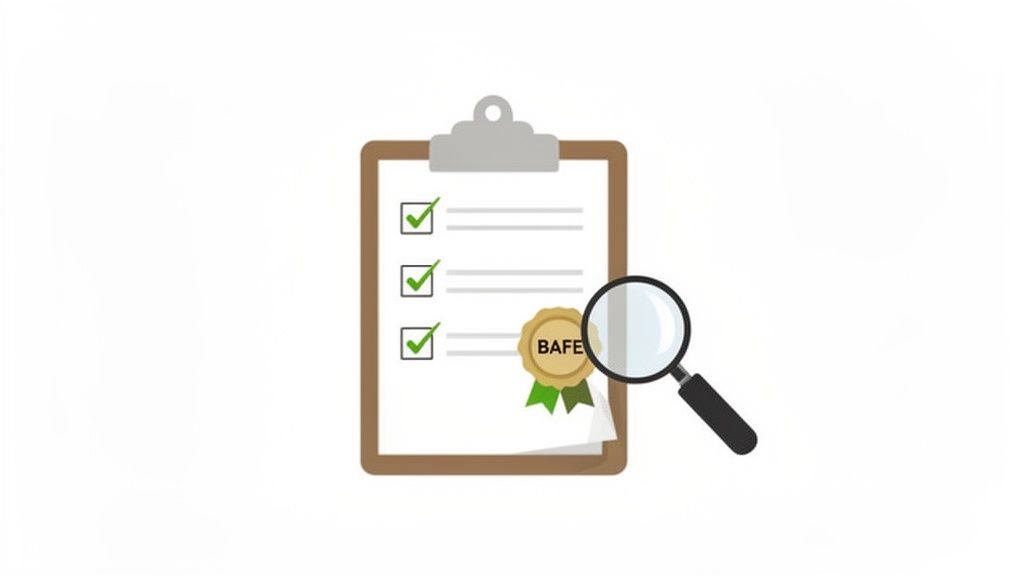
So, what does a competent assessor look like in practice? The clearest sign is third-party accreditation from a UKAS-accredited body. This is the gold standard, giving you independent proof that an assessor or their company meets tough professional standards.
Organisations like BAFE (British Approvals for Fire Equipment) run schemes that certify the competency of fire safety providers. When an assessor is BAFE-registered, it means they’ve been independently audited and confirmed to have the skills and processes needed to deliver a "suitable and sufficient" assessment.
Choosing a BAFE-registered assessor gives you real confidence that you are meeting your fire risk assessment requirements with a credible expert. It shows you’ve done your due diligence and gives you a solid defence if your assessment is ever scrutinised by the authorities.
Vetting Your Potential Assessor
Before you hire anyone, you should have a list of questions ready to confirm they’re the right fit. A genuinely competent professional will welcome this scrutiny and give you clear, confident answers.
Your vetting checklist should include these essentials:
- What are your specific qualifications and accreditations? Look for recognised industry certifications and, ideally, registration with a scheme like BAFE.
- Can you provide evidence of your experience with properties like mine? An assessor who mainly deals with office blocks might not be the best choice for a historic listed building or a complex industrial site.
- Do you hold professional indemnity and public liability insurance? This is absolutely non-negotiable. It protects you if there are errors or omissions in their work.
- Can you provide references from previous clients? Speaking to other business or property owners can give you invaluable insight into their professionalism and the quality of their work.
This thorough approach is vital because inadequate assessments are a common point of failure during official inspections. Fire and Rescue Services are conducting more audits, yet a worryingly high number of premises are still failing to get a satisfactory outcome. You can see the latest figures in these fire prevention and protection statistics from GOV.UK.
Ultimately, investing in a competent, accredited assessor is an investment in safety and your own peace of mind. It ensures your assessment is not just a document to be filed away, but a practical tool that genuinely protects your property and the people inside it.
Keeping Your Assessment on Track with Reviews and Records
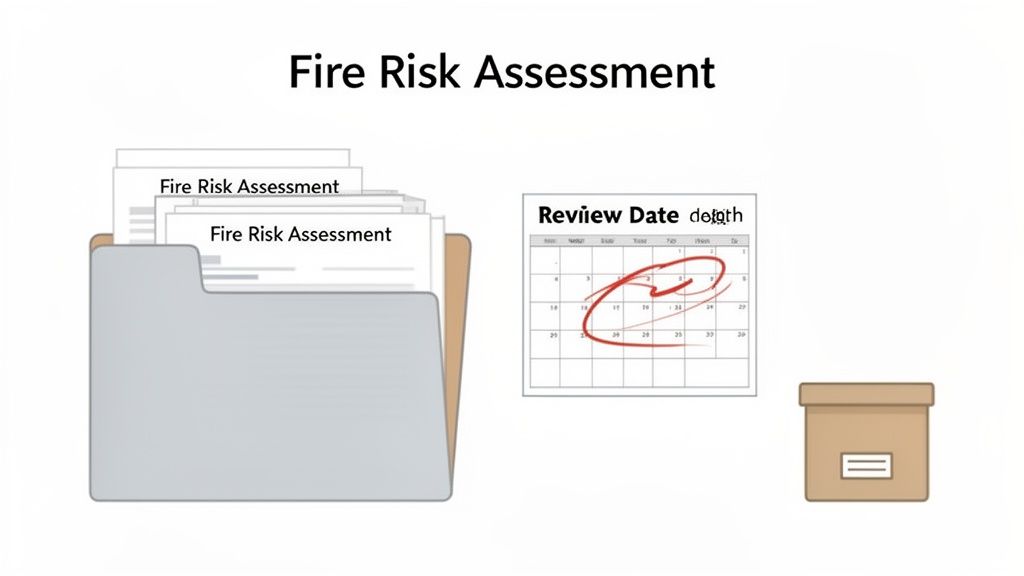
Getting your fire risk assessment done is a huge step, but it's really the start of a process, not the finish line. The law sees your assessment as a living document. It has to accurately reflect what’s happening in your building right now, not what was happening a year ago.
Sticking the report in a drawer and forgetting about it just won’t cut it. That’s not just bad practice; it means you’re failing to meet your legal duties.
Think of it like a car's MOT certificate. The certificate is only valid as long as the car stays roadworthy. If you go and swap out the engine the next day, that original MOT is suddenly pretty meaningless. Your fire risk assessment is exactly the same—it has to evolve as your property does.
When to Review Your Fire Risk Assessment
While the law doesn't set a rigid, tick-box timetable, established best practice is a formal review at least once a year. This is what fire authorities expect to see. A regular check-in ensures nothing has slipped through the cracks and your safety measures are still up to the job.
However, the rules are crystal clear on one point: you must conduct an immediate review whenever a "significant change" happens. Your fire risk assessment requirements demand that you re-evaluate the risks as soon as something shifts the safety dynamic of your building.
Common triggers that mean you need a review right away include:
- Structural Alterations: Any building work, like moving walls, adding a new floor, or changing the layout, can completely alter escape routes and fire spread.
- Changes in Occupancy: A big jump in the number of people using the building—staff, customers, or residents—changes the entire evacuation plan.
- Introduction of New Hazards: Bringing in new flammable liquids or installing powerful machinery introduces fresh ignition and fuel sources that have to be assessed.
- A Fire or Near-Miss: Any fire-related incident, no matter how small, is a massive red flag. It tells you your current controls might not be good enough and need an urgent rethink.
Failing to review your assessment after a change like this is a serious breach. An outdated assessment gives a false sense of security and is legally useless, leaving you wide open to enforcement action.
The Critical Importance of Record-Keeping
Alongside regular reviews, keeping meticulous records isn't just a good idea—it's a non-negotiable part of your legal duty. Since 1 October 2023, all businesses must keep a written record of their fire risk assessment, no matter their size. This document is the first piece of evidence a fire inspector will ask for to see if you're compliant.
Your records need to be clear, organised, and easy to get your hands on. To be considered "suitable and sufficient" by the authorities, they have to detail a few key things.
What Your Records Must Include
To meet the legal standard, your documentation has to clearly spell out:
- The Significant Findings: This is a summary of the main fire hazards you’ve spotted. Be specific. Instead of just "poor housekeeping," you need to note things like "combustible waste stored in the electrical intake cupboard."
- Protective Measures in Place: Write down what you've actually done to manage the risks. This covers everything from the fire alarm system and emergency lighting you've installed to your staff fire safety training procedures.
- Your Emergency Plan: This is your detailed, written plan explaining how everyone gets out safely. It needs to include designated escape routes, assembly points, and any special arrangements for vulnerable people.
Honestly, these records are your proof of diligence. They show an inspector that you have a proper system for fire safety, you've identified the real risks, and you've taken deliberate, documented steps to protect people.
The Real Consequences of Non-Compliance
Failing to complete your fire risk assessment isn't just a minor administrative slip-up. It carries serious, escalating consequences that can jeopardise your finances, your business, and even your personal liberty. The authorities treat fire safety failings with the gravity they deserve, and pleading ignorance is never an acceptable defence.
This isn't just about legal theory. It's about the real-world powers held by your local Fire and Rescue Service. When inspectors find breaches, they don't just offer friendly advice. They have a formal enforcement toolkit designed to compel action, moving from sharp warnings to severe penalties for those who don't listen.
Think of proactive compliance as a non-negotiable business investment, not an optional expense. The potential costs of getting it wrong—both financially and reputationally—dwarf the cost of getting it right from the start.
The Ladder of Enforcement Actions
When a fire safety officer inspects your premises and finds it wanting, they have a few different tools at their disposal, depending on how serious the problems are.
- Informal Notice: For minor issues, you might get an informal notification. It will detail the problems and give you clear advice on how to fix them.
- Alterations Notice: If your building poses a serious risk because of its structure or how it's being used, they can issue a notice requiring you to make specific changes.
- Enforcement Notice: This is a formal, legally binding order. It will list the specific failings and give you a strict deadline to sort them out. Ignoring it is a criminal offence.
In the most dangerous situations, where there is an immediate risk to life, the authorities have the power to shut you down on the spot.
A Prohibition Notice is the most severe action an inspector can take. It can prohibit or restrict the use of all or part of your premises, effective immediately, until the dangers are fixed. This means closing your business or evacuating a building until it’s deemed safe.
The Ultimate Penalties: Fines and Imprisonment
If you fail to comply with a notice or if your breaches are considered exceptionally severe, things escalate to prosecution through the courts. The penalties here are designed to be a powerful deterrent, reflecting the life-and-death importance of fire safety.
The courts have the power to impose unlimited fines on businesses and individuals found guilty of serious offences under the Fire Safety Order. These aren't just slaps on the wrist; they can be financially crippling. For the most serious breaches, particularly those that lead to death or serious injury, individuals identified as the Responsible Person can face a prison sentence of up to two years.
The rising number of fire-related incidents underscores why these penalties are so severe. In recent years, fire and rescue services have attended hundreds of thousands of incidents annually, a concerning increase that highlights the growing need for vigilance. You can explore more on these UK fire incident statistics from Astutis.
This reality puts every non-compliant property under intense scrutiny as authorities work to reverse this dangerous trend. The message from the law is crystal clear: it has sharp teeth, and failing to meet your fire risk assessment requirements is a gamble you really can't afford to take.
Common Questions on Fire Risk Assessments
Getting your head around fire safety rules can throw up a lot of practical questions. To help you feel confident you're on the right track, we’ve put together some straight answers to the queries we hear most often about fire risk assessments.
Does My Small Business Really Need One?
Yes, almost certainly. Under the Regulatory Reform (Fire Safety) Order 2005, if you’re responsible for any non-domestic property, you legally need a fire risk assessment. This isn’t just for big factories; it applies to offices, shops, warehouses, and even the shared areas of flats.
A big change came into force on 1 October 2023, making it a legal must for all businesses to keep a written record of their assessment. The old rule that let businesses with fewer than five employees off the hook is gone. Now, everyone needs a documented assessment to prove they're compliant.
How Often Should I Review My Assessment?
While the law doesn’t give a rigid timetable, it does say your assessment must be kept up to date. The established best practice—and what fire authorities expect to see—is a full review at least once every year.
That said, you are legally required to carry out an immediate review if anything significant changes. Think of it as a living document that needs to reflect the reality of your building now, not a year ago. Triggers for an instant review include:
- Building alterations that mess with escape routes or fire containment.
- A change in how the property is used or a big jump in the number of occupants.
- Bringing in new hazardous materials or processes.
- After any fire-related incident or near-miss, no matter how small it seems.
Can I Do the Fire Risk Assessment Myself?
The law says the assessment must be done by a ‘competent person’. If you run a very small, simple, low-risk workplace—say, a single-room office with just a kettle and a few computers—you might have enough knowledge to handle it yourself.
For most buildings, though, this isn't the best path. Once you get into complex layouts, multiple floors, vulnerable occupants (like in care homes), or specific fire risks, using a professional, third-party accredited assessor is the only reliable way to ensure you’re meeting the legal standard.
Remember, even if you hire an expert, as the Responsible Person, the legal buck still stops with you for the assessment's quality. Choosing a competent professional isn’t about offloading a task; it’s about making sure the job is done right.
What Happens If an Inspector Finds Problems?
If a Fire and Rescue Service audit turns up issues, they have a range of powers. The action they take depends entirely on how serious the risk is.
For minor slip-ups, you might just get some informal advice. More serious breaches could lead to a formal Enforcement Notice, which legally orders you to fix specific problems by a strict deadline. Failing to comply with that is a criminal offence.
If inspectors find an immediate, serious danger to life, they can issue a Prohibition Notice. This can shut down part or all of your premises instantly until it’s made safe. Ignoring these duties can lead to unlimited fines and, in the worst cases, even prison.
At All Well Property Services, we know that dealing with fire risk assessments is a critical part of managing any property. We work with BAFE-registered fire risk assessors to ensure your building isn’t just compliant on paper, but genuinely safe for everyone in it. Contact us today to see how we can help protect your investment and give you peace of mind.
Free tools to help plan your project
No email required. Get instant estimates and planning answers.
Planning Risk
Traffic-light check of every planning restriction at your postcode: listed buildings, conservation areas, Article 4 directions, Tree Preservation Orders, flood zones. Live data from Planning.data.gov.uk.
Listed Check
Check whether your property is a listed building or sits inside a conservation area, and what that means for renovation work. Live data from Planning.data.gov.uk and Historic England.
Post-Reno Value
Estimate what your property will be worth after planned renovation works. Select the improvements you're considering and get an estimated post-renovation value with a per-improvement breakdown and ROI figure.
VAT Rate Calculator
Find out whether your renovation qualifies for the 5% reduced VAT rate or zero rate under HMRC rules. Enter your property status and project value to see your potential saving.