Loft Conversion Planning Permission A Complete UK Guide
For most homeowners in the UK, the best news is that you often won’t need full planning permission for your loft conversion. This is all thanks to a set of rules called Permitted Development Rights (PDR), which basically give a pre-approved green light for many common home improvements, as long as they stay within strict design boundaries.
Do You Need Planning Permission For A Loft Conversion?
Think of getting your loft conversion approved like choosing between two routes for a journey. The first is a straightforward country lane, and the second is the formal, regulated motorway.
The country lane is Permitted Development—it’s quicker, quieter, and has clear, simple rules to follow. The motorway is Full Planning Permission, a more involved process for bigger or more complex journeys that need official oversight.
Which path you have to take comes down to your project's design and your property’s location. For most standard loft conversions, Permitted Development is the default route. It lets you get on with the work without a drawn-out application process, provided you stick to the rules. These include limits on the extra volume you can add, restrictions on extending beyond the front roof plane, and a requirement to use materials that match your existing home.
But if your plans are a bit more ambitious, or your property has special designations (like being in a conservation area), you’ll be directed onto the full planning permission motorway. This route means submitting detailed drawings and a formal application to your local council for their approval.
This decision tree gives you a clear visual of the two main paths for getting your loft conversion approved.
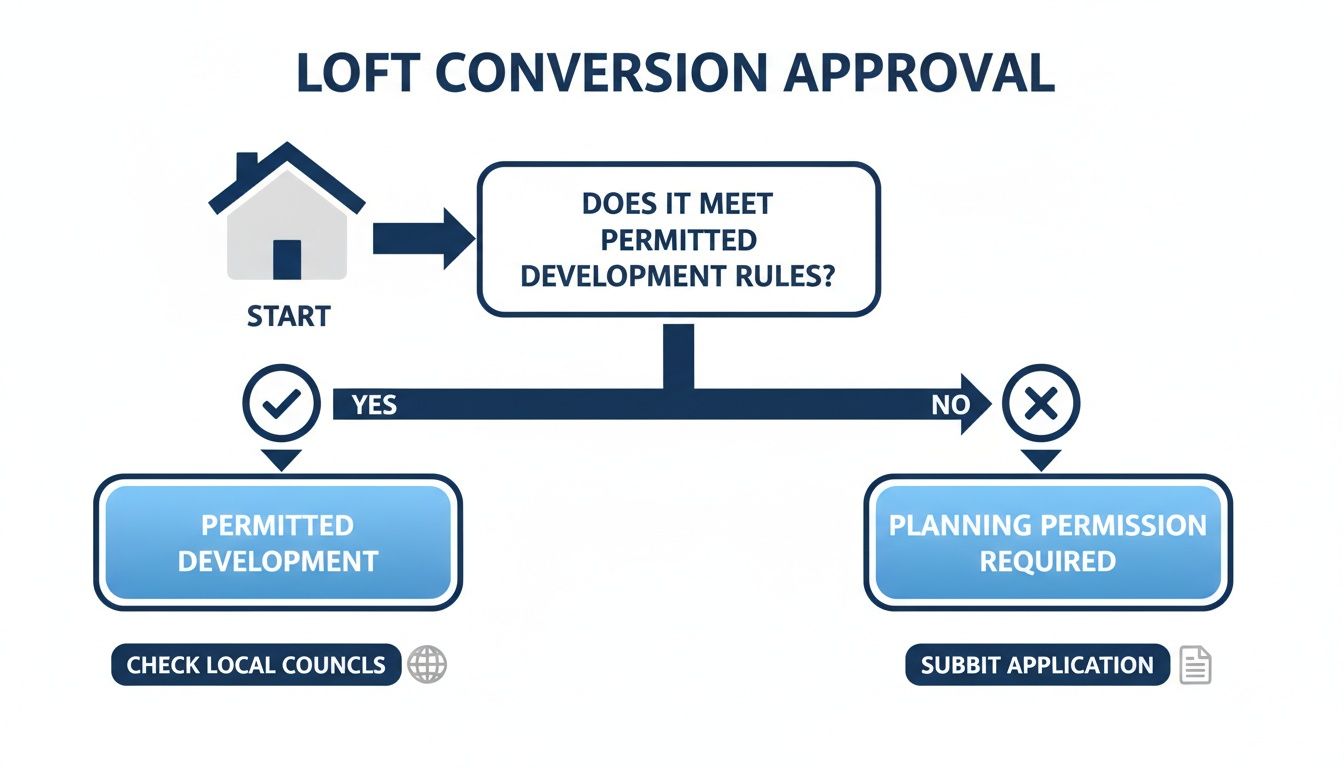
As the flowchart shows, figuring out whether your project fits within standard limits is the first—and most important—step of the whole process.
Permitted Development vs Full Planning Permission At A Glance
To help you get a quick sense of which category your project might fall into, it’s useful to see the two routes side-by-side.
This table breaks down the key differences, from the type of project and timelines to the level of scrutiny you can expect.
| Aspect | Permitted Development (PDR) | Full Planning Permission |
|---|---|---|
| Typical Use Case | Standard loft conversions within set size and design limits. | Projects that exceed PDR limits, are in restricted areas, or have complex designs. |
| Approval Process | No formal application needed, but a Lawful Development Certificate is highly recommended. | A detailed application must be submitted to and approved by the local council. |
| Timeline | An LDC application typically takes up to 8 weeks. | A decision can take 8-10 weeks, but often longer if issues arise. |
| Cost | Lower costs, mainly for drawings and the LDC application fee. | Higher costs, including architect fees, various survey reports, and a larger application fee. |
| Design Flexibility | Limited. You must adhere strictly to national criteria on size, height, and materials. | Greater flexibility, but the final design is subject to the council's subjective assessment. |
The appeal of PDR is pretty clear—it offers a faster, more certain path. The numbers back this up. In the third quarter of 2025 alone, a whopping 78% of Permitted Development applications were successful.
This high acceptance rate shows why so many homeowners aim to keep their projects on the PDR track. For a deeper dive into these trends, you can explore the UK government's latest planning statistics.
Understanding Your Permitted Development Rights
So, what are these ‘Permitted Development Rights’ you keep hearing about? Think of them as a kind of pre-approved green light from the government for certain home improvements. If your loft conversion plans fit neatly within a specific set of rules, you can skip the full-blown planning permission process. It’s a faster, more straightforward route.
This system exists because, frankly, the government knows that most sensible loft conversions don't cause any headaches for the wider community. It's a way to cut through the red tape, saving you time and money, while still making sure things don't get out of hand. But be warned: these rights are very specific, and you have to follow the rules to the letter.
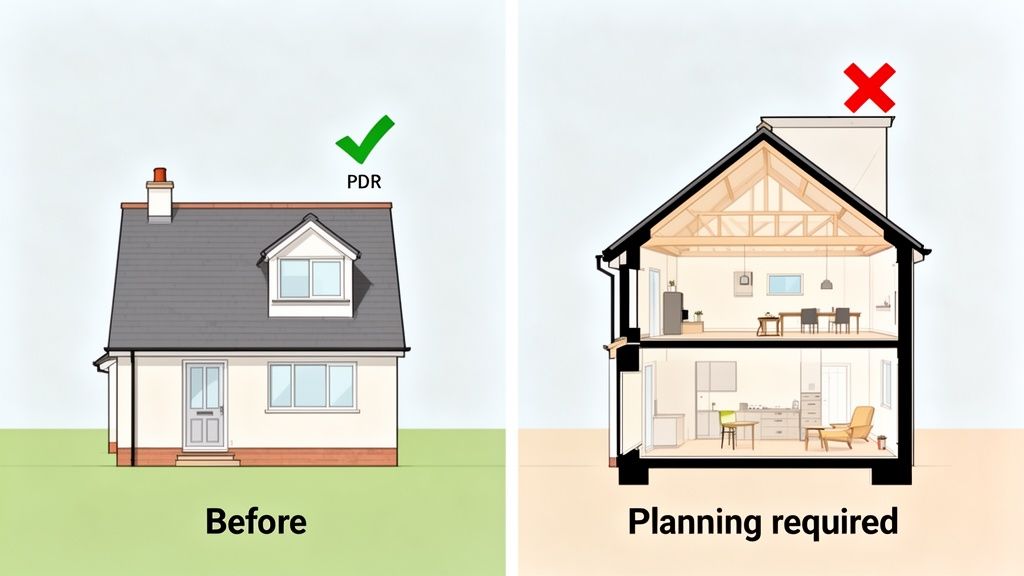
This diagram gives you a quick visual on what typically flies under Permitted Development versus what needs a full application. Sticking to these rules is the difference between a quick sign-off and a long, drawn-out planning battle.
The Core Rules For Permitted Development
To keep your project on the permitted development track, your loft conversion has to meet a strict checklist. These rules are all about controlling the size, look, and impact of the new space on your home and your neighbours.
Your design must tick these key boxes:
- Volume Limits: The new roof space you create can't be more than 40 cubic metres for a terraced house. If you're in a detached or semi-detached home, you get a bit more room to play with—up to 50 cubic metres.
- Height Restrictions: Your extension can't poke out above the highest point of your existing roof. The idea is to keep the new structure looking like it belongs, not like it’s taken over.
- Front-Facing Extensions: You can't extend beyond the existing roof slope at the front of your house (the bit that faces the road).
- Material Appearance: The materials you use on the outside have to look similar to what’s already on your house. No shiny metal cladding on a classic brick terrace, for example.
- Side-Facing Windows: Any windows on the side of the extension must be obscure-glazed. If they open, the opening part has to be at least 1.7 metres above the floor of the room. This is all about privacy for your neighbours.
- No Balconies or Verandas: Permitted development doesn't cover balconies, verandas, or any kind of raised platform.
These rules are non-negotiable. If you fall foul of just one, your project will be pushed into the full planning permission process. For a closer look at how these rules affect different designs, check out our guide on different loft conversion types.
Why A Lawful Development Certificate Is Essential
Now, even if your project meets every single one of those criteria, don't just call the builders and get started. First, you absolutely must apply for a Lawful Development Certificate (LDC) from your local council.
An LDC isn't planning permission. It's official proof from the council that your loft conversion is lawful and doesn't need planning permission. Think of it as an official seal of approval confirming you've done your homework correctly.
Getting this certificate is a no-brainer. It gives you complete peace of mind before you spend thousands on construction, protecting you if a neighbour complains or a mistake is found later on. More importantly, it’s a crucial legal document. When you eventually sell your house, any buyer’s solicitor will demand to see it.
This route is becoming incredibly popular, and for good reason. In the second quarter of 2025 alone, 44,000 householder development applications were decided, a huge chunk of them for projects like loft conversions. The grant rate for projects using Permitted Development Rights hit an impressive 88%—proof that when you follow the rules, the system really works.
When Full Planning Permission Is Required
While Permitted Development is a fantastic shortcut for many homeowners, it isn't a universal pass. Think of it as a set of general rules for typical properties. Some homes and locations, however, have special protections that override these standard rights, meaning you’ll have to apply for full loft conversion planning permission instead.
This isn’t just red tape designed to make life difficult. It’s about protecting areas with significant architectural character or natural beauty. If your property falls into one of these protected categories, the council needs to take a much closer look at your plans to ensure your loft conversion respects and preserves the unique feel of the neighbourhood. Honestly, ignoring these special conditions is one of the quickest ways to get hit with an enforcement notice.
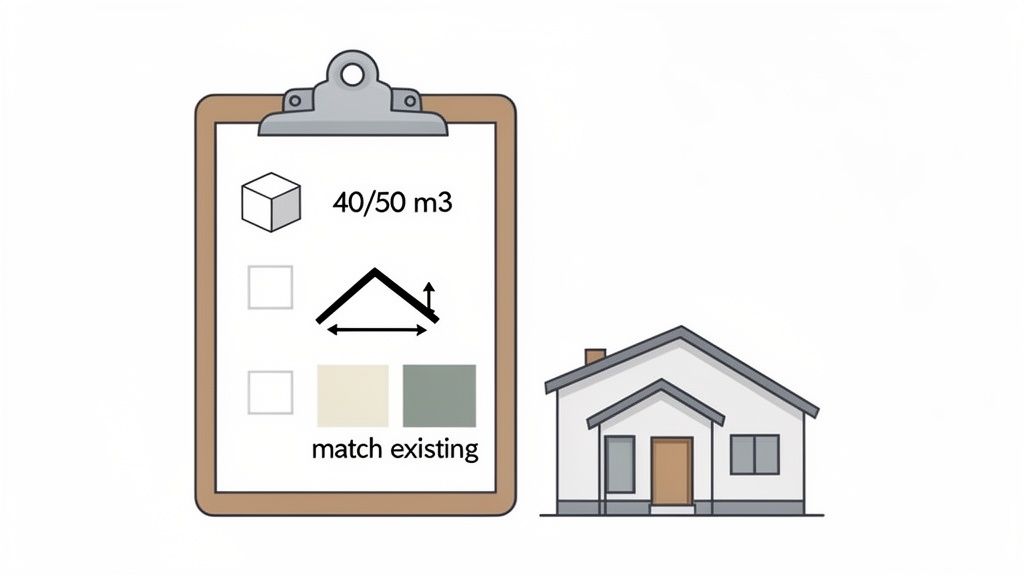
Figuring out these restrictions right at the start is crucial for a smooth project. It stops you from wasting time and money on designs that are destined for refusal from the get-go.
Properties In Specially Designated Areas
When it comes to planning, location is everything. If your home is situated within certain designated zones, your Permitted Development Rights are automatically either heavily restricted or removed entirely. The primary goal here is conservation, so any changes you make must be sympathetic to the local environment and heritage.
You will almost certainly need to apply for full planning permission if your property is located in:
- A Conservation Area: These are areas of special architectural or historic interest, and councils have a duty to preserve their character. A loft conversion that would be perfectly fine elsewhere could be seen as damaging to the area’s unique aesthetic.
- An Area of Outstanding Natural Beauty (AONB): Here, the focus is on protecting scenic beauty. Any loft conversion must be carefully designed to minimise its visual impact on the landscape.
- A National Park: Similar to AONBs, development is tightly controlled to conserve the natural environment and wildlife habitats.
- A World Heritage Site: These sites are recognised for their outstanding universal value, and any development is subject to the strictest levels of scrutiny.
- The Broads: This specific national park has its own unique planning authority and its own set of rules.
For these locations, the planning authority’s main concern is how your conversion looks from the outside. They will pay close attention to the materials, scale, and design to ensure it doesn't detract from the area's protected status.
The Impact Of Article 4 Directions
Beyond these broad area designations, local councils have another powerful tool they can use to control development: an Article 4 Direction. This is a special planning regulation that removes specific Permitted Development Rights in a very targeted area—it could be as small as a single street or even an individual building.
Councils typically use Article 4 Directions to protect the character of areas that aren't official Conservation Areas but still have a distinct, uniform architectural style they want to preserve. For example, a street of unaltered Victorian terraced houses might have an Article 4 Direction to prevent homeowners from adding dormer windows that would disrupt the original roofline.
This means that even if your loft conversion design meets all the national PDR criteria, a local Article 4 Direction could still force you to apply for full planning permission. It is essential to check your local council’s website or contact their planning department to see if any such directions apply to your property before you even think about design work.
Listed Buildings And Design Limitations
Finally, there are two other scenarios that will automatically push you down the full planning permission route, no matter where you live.
The first is if you live in a listed building. These properties are protected by law because of their historical and architectural significance. Any alteration, inside or out, that affects their special character requires Listed Building Consent, which is a separate but related process to planning permission. Your Permitted Development Rights are completely removed.
The second scenario is all about your design choices. Even if your property isn’t in a protected area, you’ll still need full planning permission if your design includes features that are explicitly excluded from Permitted Development Rights, such as:
- Balconies
- Verandas
- Raised platforms
These features are considered to have a much bigger impact on your neighbours' privacy and the general street scene, so they require the detailed assessment that only comes with a full planning application.
Navigating Building Regulations And Party Wall Agreements
Getting the green light for your build, whether through permitted development or a full planning application, is a huge step. But it’s not the last legal hurdle you’ll face. Beyond loft conversion planning permission, every single project has to deal with two other critical sets of rules: Building Regulations and the Party Wall Act.
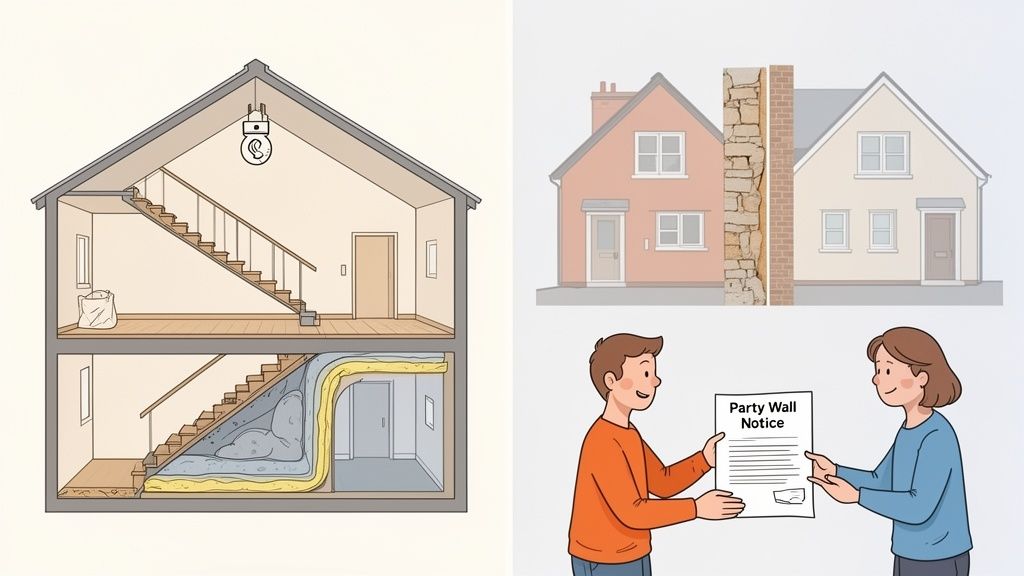
Here’s a simple way to think about it: planning permission decides if you can build. Building Regulations dictate how you must build it to be safe, warm, and structurally sound. The Party Wall Act, on the other hand, is all about being a good neighbour and following a legal process when your work affects a shared wall.
The Role Of Building Regulations
Building Regulations are a set of national standards for how buildings are designed and constructed. They have nothing to do with planning permission and are completely non-negotiable for any loft conversion. Their entire purpose is to protect the health and safety of people in and around the building.
Compliance is mandatory. The work is checked by a Building Control Officer from your local council or an approved private inspector, who will visit your project at key stages to sign everything off.
Key areas covered by Building Regulations include:
- Structural Integrity: This makes sure the new floor joists are strong enough to take the weight of a living space and that any new beams or roof alterations are structurally sound.
- Fire Safety: This is a massive one. It covers installing mains-powered smoke alarms, ensuring there are proper escape routes (usually via protected stairways), and using fire-resistant doors.
- Staircase Design: The rules get very specific about minimum headroom, maximum pitch, and the design of handrails to ensure the new stairs are safe.
- Insulation and Ventilation: Your new loft has to meet strict thermal efficiency standards to stop heat from escaping. It also needs proper ventilation to prevent damp and condensation issues.
You can dive deeper into how these rules apply in our guide comparing planning permission and building regulations for conversions.
Understanding The Party Wall Act
If your home is terraced or semi-detached, you share a wall with a neighbour. This is called a ‘party wall’, and any work that could affect it falls under the Party Wall etc. Act 1996. The legislation is there to prevent disputes by making sure your neighbours are properly notified about the work you’re planning.
A common myth is that the Act gives your neighbour the power to stop your conversion. It doesn't. Its job is to make sure you carry out the work in a way that doesn’t damage their property.
The Party Wall Act isn't about asking your neighbour for permission. It's a legal framework that requires you to formally notify them of your plans, giving them the chance to have the work independently checked to protect their home.
Skipping this step can lead to expensive legal battles and even court injunctions that could grind your project to a halt.
Serving A Party Wall Notice
Before any work kicks off on or near the party wall, you must serve a formal Party Wall Notice to all affected neighbours. This is a written notice that lays out exactly what you plan to do and must be served at least two months before you intend to start.
Your neighbour has three ways they can respond:
- Consent in Writing: They agree to the work, and you’re good to go. It’s always a smart move to take dated photos of their side of the wall beforehand, just to protect everyone.
- Dissent and Appoint a Surveyor: They disagree, or they don't reply within 14 days (which legally counts as a dissent). If this happens, you both appoint surveyors who will agree on a Party Wall Award—a legal document that sets out the rules for how the work will be done.
- Dissent and Appoint an Agreed Surveyor: To keep costs down, you and your neighbour can agree to use a single, impartial surveyor who will draw up the Award.
Getting this process right is vital for keeping good relationships and making sure your project moves forward without legal delays. Many homeowners hire a professional Party Wall Surveyor to handle the whole thing, just to be certain everything is done by the book.
Your Application Checklist, Timelines, And Costs
Let's be honest, the whole planning and permissions stage can feel like a maze. But breaking it down into a clear, step-by-step plan is the secret to a stress-free project. This is your roadmap for the entire pre-build journey, from scribbling ideas on a napkin to getting the final green light. It’ll give you a realistic idea of the schedule and budget you need before a single hammer is swung.
Think of it as your pre-flight checklist. Ticking off each box methodically takes the guesswork out of the process, ensuring a smooth take-off for your build.
Key Stages Of The Pre-Build Process
Before the construction crew arrives, there are a few crucial admin and design hoops to jump through. Each stage builds on the one before it, creating the solid legal and technical foundation your project needs.
-
Initial Design and Feasibility: This is the creative kick-off with your architect. You’ll figure out what’s actually possible, discussing your vision, your budget, and the best type of loft conversion for your home—all while keeping those Permitted Development rules front and centre.
-
Commissioning Architectural Drawings: Once the concept is solid, your architect gets to work on the detailed drawings. These aren’t just rough sketches; they're the precise blueprints that will be used for your planning application (if you need one) and by the build team.
-
Appointing a Structural Engineer: Your architect’s brilliant design needs to be structurally sound. A structural engineer steps in here, running all the necessary calculations for steel beams (RSJs), floor joists, and any roof changes. Their drawings ensure the new structure is safe, robust, and up to code.
-
Submitting Your Application: With your architectural and structural plans ready, it’s time to submit your application. This will either be for a Lawful Development Certificate (for PD projects) or full planning permission, usually done through the official Planning Portal.
-
Handling Party Wall Matters: If you share a wall with a neighbour (i.e., you live in a terraced or semi-detached house), now is the time to formally serve them a Party Wall Notice. It’s smart to get this process running in parallel with your planning application to avoid any hold-ups later on.
-
Arranging Building Control: The final piece of the puzzle. You’ll submit your technical drawings to either the local council's Building Control department or an approved private inspector. They check everything for compliance with Building Regulations and will schedule inspections at key points during the build.
Estimated Timelines And Costs For Loft Conversion Approval
Getting a grip on the time and money involved in these early stages is absolutely vital for planning your project properly. Every loft conversion is a bit different, of course, but the table below gives you a realistic overview of what to expect before the build itself begins. It’s always wise to build a little buffer into your schedule, as delays can and do happen.
| Phase | Typical Timeline | Estimated Cost (UK) |
|---|---|---|
| Architectural Drawings | 2–4 weeks | £1,000 – £3,000 |
| Structural Engineer Fees | 1–3 weeks | £800 – £2,000 |
| Planning Application Decision | 8–10 weeks | £206 (Full App) / £103 (LDC) |
| Party Wall Surveyor | 4–8 weeks | £800 – £1,500 per neighbour |
| Building Control Fees | Varies | £600 – £1,200 |
Just a heads-up: these figures are for the pre-build phase only. They don’t cover the actual construction work. To get a better feel for the total project spend, it’s worth plugging your details into our detailed loft conversion cost calculator.
Recent trends really show how much smoother the Permitted Development route can be. While overall planning applications in England hit a slump in late 2024, the first quarter of 2025 saw a big comeback, driven by a surge in PD applications for projects just like loft conversions. The numbers speak for themselves: between 78-80% of these applications are approved each quarter. This really hammers home why sticking within PD guidelines is such a smart move for homeowners. You can dig into the numbers yourself by reviewing the government's official planning statistics.
Common Questions About Loft Conversion Planning
Even when you’ve got a handle on the main rules, the world of loft conversion planning permission can throw some tricky, real-world questions your way. Practical situations often don't fit neatly into the general guidelines.
Think of this section as your quick-reference guide. We’ve pulled together the most common queries that crop up during planning and given clear, straightforward answers to help you sidestep common pitfalls and keep your project moving.
What Happens If My Application Is Refused?
Getting a refusal notice can feel like a huge blow, but it’s rarely the end of the line. The first thing you need to do is carefully read the council’s reasons for their decision. These documents spell out exactly which local or national planning policies your design didn't meet.
Once you know what the issues are, you generally have three ways forward:
- Amend and Resubmit: This is the most common path. You and your architect can tweak the plans to fix the council's specific concerns—maybe by shrinking a dormer or changing the materials—and then resubmit the application.
- Appeal the Decision: If you and your planning advisor genuinely believe the council got it wrong, you can appeal to the national Planning Inspectorate. It’s a more formal and time-consuming process, but it can be worth it if you have a solid case.
- Walk Away: Sometimes, the changes needed to get approval would make the project unworkable or just not what you wanted. It’s the least ideal option, but it's important to know when a design simply won’t fly.
Do I Need My Neighbour's Permission?
This is a massive point of confusion for a lot of homeowners. For loft conversion planning permission, you do not need your neighbour’s official consent. However, the council will notify them about your application, giving them a window to submit comments or objections.
Planners will only consider valid objections related to planning matters, like loss of light or privacy. They’ll ignore personal disputes or anything not covered by planning law. It's a completely separate issue from the Party Wall Act, which is a legal requirement where you must formally notify neighbours about work on a shared wall. That’s a civil matter, not a planning one.
Are There Special Rules For Windows?
Yes, absolutely. Window design is a detail planning authorities look at very closely, especially under Permitted Development Rights. The rules are all about protecting your neighbours' privacy.
- Side-Facing Windows: Any window on the side elevation of your loft conversion must be obscure-glazed. This just means you can’t see through it clearly.
- Opening Height: If that side-facing window can be opened, the opening part must be at least 1.7 metres above the floor of the room it’s in. This is to stop people from directly overlooking a neighbour’s property.
Front and rear-facing windows usually have a bit more wiggle room, but if you’re in a Conservation Area or under an Article 4 Direction, the style and materials might be heavily restricted to match the original house.
Remember, these rules are non-negotiable if you want to stay within Permitted Development. A non-compliant window is enough to force you into a full planning application, even if every other part of your design is perfect. Getting this small detail right is crucial.
Can I Add A Balcony Or Terrace?
Under Permitted Development Rights, the answer is a simple, straightforward no. Balconies, verandas, and any kind of raised platform are explicitly forbidden. If you want to create an outdoor space like this, you will always have to submit a full planning application.
The reason is simple: balconies can have a huge impact on neighbouring homes by overlooking them and causing a loss of privacy. When a planning officer looks at an application for a balcony, they’ll pay incredibly close attention to where it's positioned and how it affects the people living around you. While getting one approved isn't impossible, it's definitely one of the tougher design elements to get past the council.
Navigating the specifics of planning permission, building regulations, and party wall agreements can be complex. Working with an experienced team that manages the entire process is the surest way to a smooth, successful project. At All Well Property Services, we handle everything from initial drawings and council submissions to final construction, ensuring your loft conversion is fully compliant and beautifully finished.
If you're ready to transform your home, get in touch with our team today for a no-obligation consultation.
Article created using Outrank
Free tools to help plan your project
No email required. Get instant estimates and planning answers.
Loft Cost Calculator
Estimate the cost of your loft conversion based on type (dormer, mansard, hip-to-gable), intended use, and location in South East London.
Post-Reno Value
Estimate what your property will be worth after planned renovation works. Select the improvements you're considering and get an estimated post-renovation value with a per-improvement breakdown and ROI figure.
BC Fees Calculator
Estimate LABC plan check and inspection fees for your project. Compare local authority Building Control against private Approved Inspectors, with borough cost adjustments.
Planning Risk
Traffic-light check of every planning restriction at your postcode: listed buildings, conservation areas, Article 4 directions, Tree Preservation Orders, flood zones. Live data from Planning.data.gov.uk.