Navigating the Building Control Approval Process in London
Starting a renovation in London, whether it’s a Southwark loft conversion or a Wandsworth kitchen extension, means you’ll be navigating the building control approval process. This isn’t just bureaucratic red tape; it's a legal must-have that makes sure your home is safe, structurally sound, and energy-efficient.
Your Roadmap to Building Regulations Approval
This guide is here to demystify the entire journey, starting with the crucial difference between Building Regulations (the how) and Planning Permission (the what). People mix these two up all the time, but they serve completely different purposes and run on separate tracks. Getting one doesn't mean you have the other.
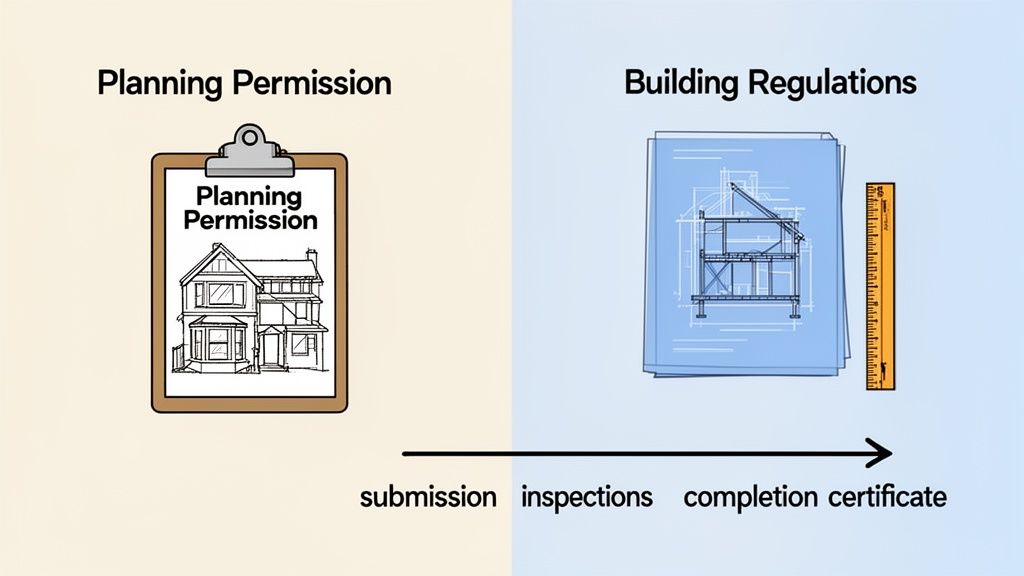
Here's the simplest way to think about it:
- Planning Permission is all about whether you have the right to build your project. It looks at the big picture—the appearance of your extension, its size, and how it affects your neighbours and the street.
- Building Regulations focus on how you will build it. This is where the technical details come in, making sure the construction meets national standards for health and safety.
Getting this distinction right is fundamental. I’ve seen homeowners in Clapham get planning permission for a stunning rear extension, only to hit a wall later because they never got a building control completion certificate. Without it, the project isn't legally finished, which creates huge problems when you try to sell or remortgage.
The Two Paths to Compliance
You essentially have two main routes to get approval: a Full Plans application or a Building Notice. The one you choose is a strategic decision that affects your project's timeline and how much risk you're willing to take on.
A Full Plans application is the belt-and-braces approach. You submit a full set of detailed drawings and technical specifications for approval before any work begins. This gives you peace of mind that your designs are compliant right from the start.
On the other hand, a Building Notice just tells the local authority that you plan to start work. There are no detailed plans approved upfront; compliance is checked on the fly through site inspections as the project progresses. It’s faster to get started but can be riskier if issues crop up mid-build.
The whole point of the building control approval process is simple: to ensure your finished project is safe for anyone living in it. It covers everything from structural integrity and fire safety to drainage, ventilation, and energy efficiency.
Consider this guide your roadmap for turning what feels like a complex legal hoop into a smooth, predictable part of your renovation. We'll map out the key stages, from that first application to securing your vital completion certificate. Whether you’re working on a period property in Forest Hill or a modern flat in Kensington, getting this right is non-negotiable. If you need a hand with the technical side, you might be interested in our dedicated structural compliance services.
Choosing Your Application Route: Full Plans vs Building Notice
Right, let's get into the first big decision you'll make in the building control process. This isn't just about filling in a form; it's a strategic choice that sets the tone for your project's timeline, budget, and how much risk you're willing to take on. Get this right, and you’re aligning the entire regulatory process with the scale of your build from day one.
You have two main paths: the Full Plans application or the Building Notice. One gives you certainty and a pre-approved roadmap, while the other is a faster, leaner option for smaller jobs. Neither is better than the other—it all comes down to your specific project and how comfortable you are with potential on-the-fly problem-solving.
The Full Plans Application Explained
Think of a Full Plans application as your project's detailed blueprint, fully vetted and stamped for approval before a single spade hits the ground. This route involves submitting a complete set of architectural drawings, structural calculations, and technical specifications to your local authority's Building Control department for a thorough check.
An officer will go through every single detail—from the foundation design and insulation values to fire safety measures—making sure your plans are fully compliant with the Building Regulations. Once they're happy, they issue a formal approval. This gives you, your builder, and your mortgage lender maximum confidence that the work you’re planning is sound.
A Full Plans approval is basically a certificate of compliance for your design. It massively de-risks the construction phase because your builder has a pre-approved set of plans to follow, which seriously cuts down the chances of needing costly fixes on-site.
For instance, a complex basement conversion in an Islington terraced house, involving major excavation and structural gymnastics, is a perfect candidate for a Full Plans application. The upfront scrutiny provides peace of mind that all the tricky structural and waterproofing details have been properly ironed out before the diggers arrive.
When to Use a Building Notice
A Building Notice is a different beast entirely. It’s essentially a heads-up to your local authority, letting them know you plan to start building work. You have to submit it at least 48 hours before you begin. Critically, you don't submit detailed drawings for pre-approval. Instead, compliance is checked and signed off by a building control surveyor during site inspections as the work progresses.
This route is much quicker to get started, which makes it tempting for homeowners keen to crack on. However, it piles a lot more responsibility onto you and your builder to ensure the work meets all the regulations as you go. If a surveyor spots a non-compliant detail during an inspection, you’ll have to alter or even rip it out at your own expense.
This approach is best suited for straightforward, low-risk jobs. Imagine you’re removing a non-load-bearing internal wall in a Hackney flat. A competent builder can tackle that with confidence, knowing it will meet the standards, making a Building Notice a perfectly sensible and efficient choice.
But using a Building Notice for complex projects like an extension or loft conversion is a huge gamble. Without approved plans, it's your word against the inspector's if a dispute arises, and putting things right can be incredibly disruptive and expensive. Plus, you won't receive a formal approval notice for the plans, which some mortgage lenders or warranty providers might kick up a fuss about.
Full Plans vs Building Notice at a Glance
So, how do you decide? It really comes down to weighing up the trade-offs between upfront certainty and a faster start. A well-managed project begins with picking the path that best suits its complexity. Honestly, for most homeowners, the small amount of extra time and cost involved in a Full Plans application is a very worthwhile investment for the peace of mind it brings.
And remember, if your project falls under Permitted Development rights, the rules can feel a bit different. You might find our ultimate guide to Permitted Development in London helps clear things up.
Here’s a direct comparison to help you choose the right path for your renovation.
| Feature | Full Plans Application | Building Notice |
|---|---|---|
| Upfront Certainty | High. Plans are formally approved before work starts, providing a clear roadmap for your builder. | Low. Compliance is checked during construction, which can lead to on-site changes. |
| Project Suitability | Ideal for complex jobs: extensions, loft conversions, structural alterations, and basement works. | Best for simple jobs: minor internal changes, drainage alterations, and small repairs. |
| Risk Profile | Lower risk. Potential issues are identified and resolved at the design stage. | Higher risk. Non-compliant work may need to be corrected at your expense during the build. |
| Timeline to Start | Slower. Typically takes 5-8 weeks for the local authority to review and approve the plans. | Faster. You can legally start work 48 hours after submitting the notice. |
| Documentation | Provides a formal approval notice and a final Completion Certificate. | Only provides a final Completion Certificate; no upfront design approval is issued. |
Ultimately, choosing a Full Plans application is about investing in certainty. While a Building Notice gets you moving faster, the potential for unforeseen problems and extra costs during construction is much higher. For any project involving structural changes, the Full Plans route is almost always the smarter, safer bet.
Assembling a Bulletproof Building Control Application
A successful submission really comes down to meticulous preparation. This is your practical playbook for pulling together the right documents and dodging the common delays that incomplete paperwork can cause. Honestly, putting together a robust application package is the best way to make sure your project gets validated and approved without a hitch.
Think of your application as the complete technical story of your project. It needs to give the building control body everything they need to confirm your plans meet national safety and performance standards. Leaving details out is the fastest way to get your application rejected or slowed down by endless requests for more information.
Your Essential Documentation Checklist
The core of any solid Full Plans application is a set of precise, detailed documents. Vague sketches or missing information just won't cut it. You're aiming for a package so complete that the building control officer has no questions left to ask.
Here are the critical components you'll need to get right:
- Detailed Architectural Drawings: These are the foundation of your submission. They must be professionally drawn to a recognised scale (usually 1:50 or 1:100) and include floor plans, elevations, and cross-sections of the proposed work. They should be fully annotated with dimensions, materials, and construction details.
- Structural Calculations and Drawings: For any project involving structural changes—like removing a wall, adding a loft, or building an extension—a structural engineer has to produce a full set of calculations. These prove that the new steel beams, foundations, and support posts are safe and up to the job.
- Comprehensive Specifications: This document gets into the nitty-gritty, detailing the specific materials and construction methods you'll use. It covers everything from the type of insulation in the walls and roof to the damp-proof course and ventilation systems.
Beyond these core elements, you'll also need to provide specific plans for key compliance areas, and this is where many applications fall short. For example, you must show how your design addresses fire safety, including escape routes and the correct fire-resistant materials. A clear drainage plan is also essential, showing how new bathrooms or kitchens will connect to the existing system.
You can explore how these rules apply in more detail by reading our guide on kitchen extension building regulations.
Local Authority vs Approved Inspector
Another key decision is who will oversee your project's compliance. You have two options for your building control approval process: your Local Authority Building Control (LABC) or a private firm known as an Approved Inspector.
LABC is the traditional route, run by your local council. They have a deep knowledge of the local area, which can be invaluable, especially for projects on tricky sites or in conservation areas. They also tend to be non-profit-driven, focusing purely on compliance.
Approved Inspectors, on the other hand, are private companies licensed to carry out the building control function. They often offer a more flexible and proactive service, sometimes assigning a single surveyor to your project from start to finish. This can lead to a more collaborative working relationship. Their fees are often competitive, but the choice really comes down to service and preference.
Your decision between LABC and an Approved Inspector doesn't change the regulations you must meet. The standards are national and identical for both. The difference lies in their approach, responsiveness, and how they structure their service.
Regardless of who you choose, the quality of your submission is what matters most. An application packed with clear, accurate information is the secret to a smooth journey. It demonstrates professionalism and shows the inspector that you and your team have thoroughly considered every aspect of compliance. This builds trust from day one and sets a positive tone for the entire project, from the initial review right through to the final site inspection.
Navigating Site Inspections and Key Construction Milestones
Once your application gets the green light, the building control approval process moves from your desk to your property. This is where the real action begins: the site inspection phase. A building control surveyor will visit your project at key stages to make sure the work on the ground lines up with the approved plans and meets all the regulations. Getting this part right is absolutely vital for keeping your project on track and avoiding expensive mistakes.
Think of the inspection schedule as a series of crucial checkpoints. It’s not random; each visit is triggered when your builder hits a critical construction milestone. Your builder is responsible for giving the building control body (either the local authority or your Approved Inspector) at least 24-48 hours’ notice before they’re ready for an inspection. This is non-negotiable.
The initial submission process, which gets you to this point, is all about laying the groundwork with solid plans before an officer even sees them.
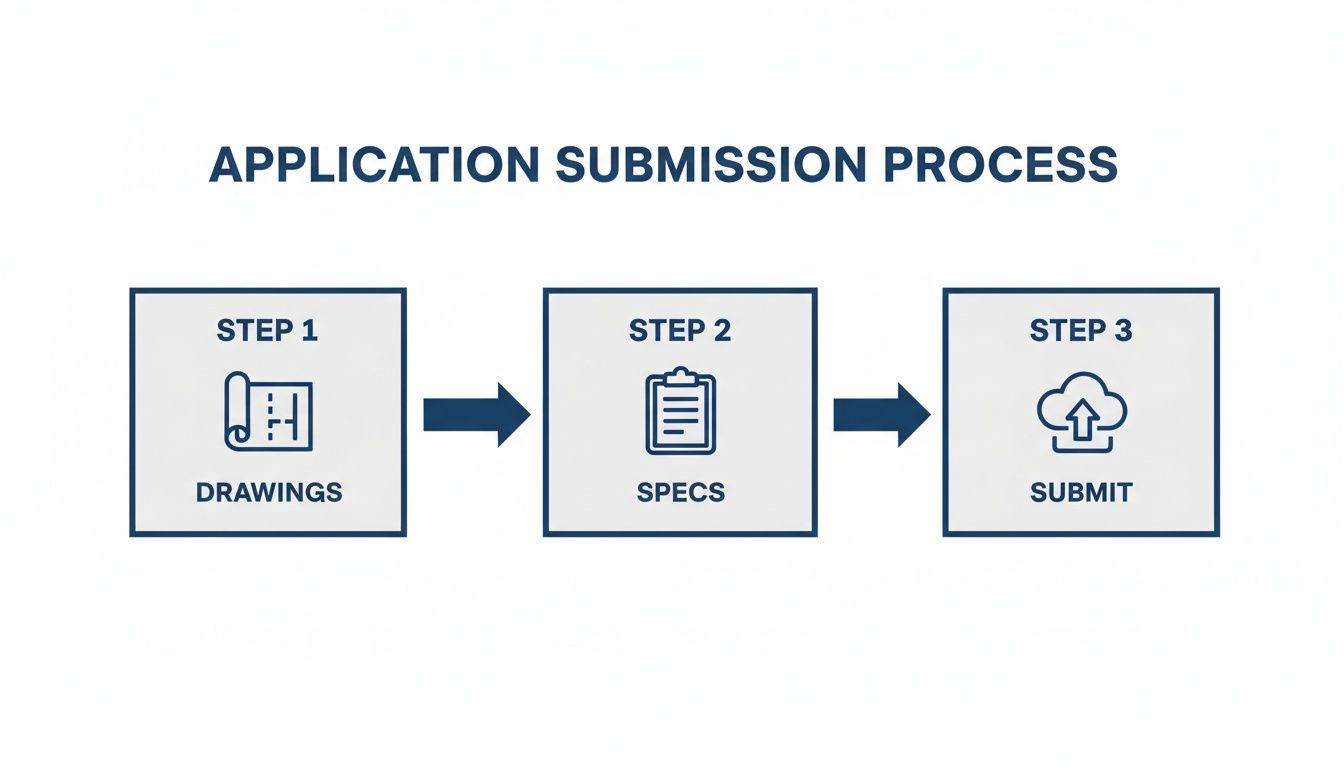
As you can see, a successful application is built on a foundation of detailed plans and precise specifications, setting the stage for the physical checks to come.
The Typical Inspection Timetable
While every project has its quirks, the inspection schedule for most extensions, loft conversions, or major refurbs follows a pretty predictable path. Your builder can’t move on to the next phase until the previous one has been signed off. This ensures quality and compliance are baked in from the start, not just tacked on at the end.
Here are the most common inspection points:
- Commencement: The first visit. It confirms the project is underway and gives the surveyor a chance to chat with your build team about the plan and the upcoming inspection schedule.
- Foundation Excavations: This one’s a big deal. The surveyor inspects the trenches before any concrete is poured to check the ground conditions are suitable and the depth matches the approved design.
- Damp-Proof Course (DPC): Once the blockwork is up to floor level, the inspector checks that the DPC and any damp-proof membranes are installed correctly. This is your defence against future moisture problems.
- Drainage: All new drainage pipes are inspected before being covered up. The surveyor will be looking at the pipe material, the gradient (the "fall"), connections, and bedding to make sure everything flows as it should.
- Structural Openings and Beams: When steel beams or lintels go in, they must be checked while still exposed. The inspector will verify the beam size, its bearings, and that the fire protection is up to scratch.
- Roof Structure: Before any tiles go on, a visit is needed to inspect the timber structure, bracing, and insulation. This ensures it's structurally sound and meets thermal efficiency standards.
- Completion: The final hurdle. This is a comprehensive review of the finished project to confirm every aspect of the Building Regulations has been met, from fire safety and ventilation to providing the right electrical safety certificates.
The Cost of a Missed Inspection
So, what happens if your builder forgets to call for an inspection? The fallout can be pretty severe. I saw a project in Balham where the builder poured the entire ground floor slab without getting the foundations signed off. The building control officer made them dig several costly trial holes to prove the foundation depth retrospectively. It caused a two-week delay and a painful extra expense.
A missed inspection puts the entire project's compliance in jeopardy. The surveyor has every right to ask you to uncover, expose, or even dismantle finished work to verify what’s underneath. It’s a disruptive and entirely avoidable headache.
This is exactly why clear, constant communication between your builder and the inspector is so important. At All Well, we manage this dialogue for our clients, ensuring every key stage is notified, inspected, and approved right on schedule. It just keeps the whole project flowing without any nasty surprises.
London Application Timelines
Managing this process efficiently is key, especially when you look at the timelines involved. Recent performance data for London showed that out of 409 decisions made, the median time to a decision was 18 weeks. This broke down into 36% of applications being deemed invalid (taking a week to spot), 18% being rejected (after 28 weeks), and 31% gaining approval (after 29 weeks). These figures really hammer home how important it is to submit a perfect application from day one to avoid long, frustrating delays. You can read more in the Building Safety Regulator's findings.
By understanding these milestones, you can keep a better eye on your project and make sure your team is hitting the marks needed to get you to a successful, fully certified completion.
Securing Your Final Completion Certificate
The finish line is in sight.## Securing Your Final Completion Certificate
The finish line is in sight. Getting your final Completion Certificate is the last step in the entire building control approval process. Honestly, this document is much more than just a piece of paper—it’s the official, legally recognised proof that your project was built correctly and meets the Building Regulations. You absolutely need it if you ever plan to sell or remortgage your property.
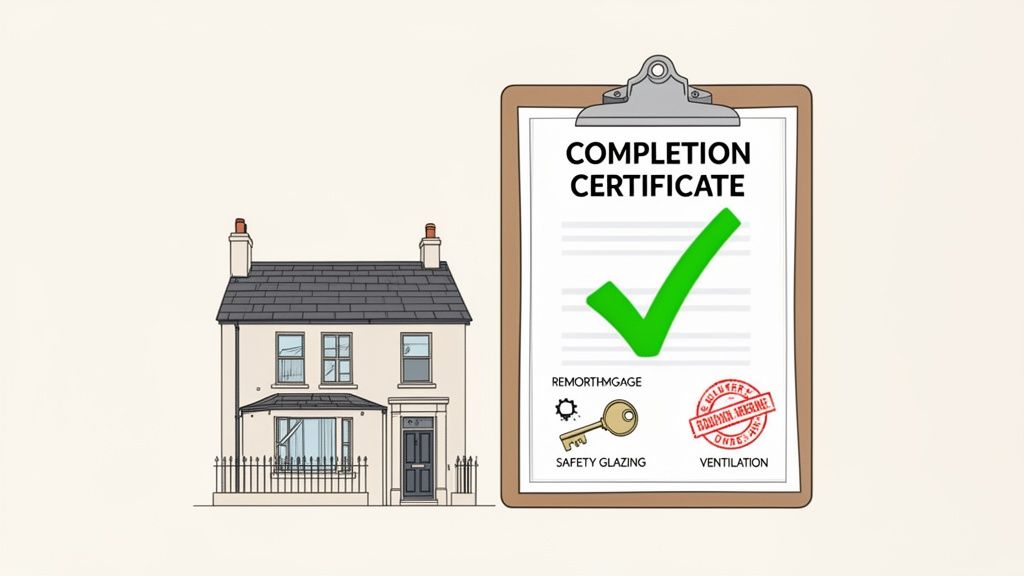
Think of it as the project’s official sign-off. Without it, your local authority could technically take enforcement action. More likely, a prospective buyer’s solicitor will flag its absence in a heartbeat, which could easily derail a future sale.
The Final Inspection
Once all the work is done and dusted, you’ll need to book a final inspection with your building control surveyor to get your certificate. This is the last and most thorough check-up of the lot. The surveyor will visit the site to confirm that every last detail aligns with the regulations and the plans they approved.
They aren't just there to admire the paint job. Their focus is on the critical safety and performance elements that are often hidden away behind plasterboard and flooring.
This final check is your last chance to prove compliance. The surveyor needs to be satisfied that everything, from fire safety measures to energy efficiency, has been correctly implemented before they will issue the certificate.
It’s reassuring to know that for projects across the UK, the focus on compliance is paying off. Recent data shows impressive approval rates, with London's performance hitting 83% of decisions resulting in approvals across 13,674 residential units. This high success rate shows that a well-managed project has an excellent chance of a smooth sign-off. You can read more about the Building Safety Regulator's findings on approval rates.
Common Roadblocks to Completion
I’ve seen a few common issues delay the issue of a Completion Certificate time and time again. Knowing what these potential tripwires are ahead of time can save you a lot of stress and last-minute scrambling. These are the details that often get overlooked in the final rush to finish.
Here are the usual suspects for a delayed sign-off:
- Missing Electrical Certificates: You must give the surveyor the BS 7671 electrical installation certificate from your NICEIC-registered electrician. No certificate, no sign-off.
- Gas Safety Records: If any gas appliances were installed or moved, a certificate from a Gas Safe registered engineer is mandatory.
- Incorrect Safety Glazing: Glazing in critical spots—like doors and low-level windows—must be toughened or laminated safety glass. The surveyor will be looking for the official kite mark.
- Inadequate Ventilation: This is a big one. Bathrooms, kitchens, and utility rooms must have the correct mechanical extractor fans installed and properly ducted to the outside.
- Fire Safety Details: The inspector will check for correctly fitted smoke and heat detectors, and make sure any fire doors have the right intumescent strips and self-closers.
My best advice? Create a completion file with all your necessary certificates and warranties before the surveyor even steps on site. Having this organised and ready to hand over shows them you’ve managed the process diligently. It creates a great impression and helps make their final check a straightforward and positive experience, bringing your project to a successful close.
Got Questions About Building Control? We've Got Answers
Even the most straightforward projects can throw up a few curveballs during the building control approval process. It’s completely normal. We hear the same questions crop up time and again from homeowners across London, so we've put together some straight-talking answers to clear things up.
How Long Does Building Control Approval Actually Take?
This is the big one, isn't it? For a Full Plans application, you should realistically set aside five to eight weeks from submission to getting a decision back from your building control body. But that's only if everything is perfect from day one.
If anything's missing—structural calculations, a proper drainage plan, you name it—they'll hit pause and ask for more information. That stops the clock and drags out your timeline. A Building Notice is much faster off the blocks, letting you start work just 48 hours after you've submitted it. Just remember, that doesn't mean your project is approved, only that the process has officially started.
Is There Any Way to Speed Things Up?
Absolutely. The single best thing you can do is give them a flawless application. A well-prepared, comprehensive package with detailed drawings and all the supporting documents makes the plan checker's job a breeze. It massively cuts down the chances of them coming back with queries.
We're also seeing some great improvements thanks to the new Building Safety Regulator. Their Gateway 2 processes have seriously cut down approval times for UK building control applications, which is fantastic news for anyone renovating in London. A properly prepared application can now get approval in just 12-13 weeks, a huge improvement on the old model which could take a painful 32-38 weeks. You can read more on the updated building control approval timelines.
What Happens If My Application Gets Rejected?
Getting a rejection notice can feel like a punch to the gut, but don't panic. It’s almost always fixable. A rejection isn't a final 'no'; it's a detailed list of what needs correcting before your plans can be approved.
Your architect or designer will need to go through the points raised by the building control body and amend the drawings and specs accordingly. Once that’s done, you can resubmit. This is exactly why the Full Plans route is so valuable—it gets these issues ironed out on paper, not with costly, stressful changes once your builder is already on site.
A rejection notice is just a formal to-do list to make your design compliant. Think of it as a critical feedback loop that ensures your project will be built safely and to the correct standards.
What's The Difference Between Building Control And Planning Permission?
This is probably the most common point of confusion, but the distinction is crucial. Here’s the simplest way to think about it:
- Planning Permission is about the principle of what you want to build. It looks at the visual impact, size, and use of your project and its effect on your neighbours and the local area. Essentially, it's about whether you have the right to build.
- Building Control Approval is all about the technical side of the construction. It makes sure the work meets national standards for things like structural integrity, fire safety, energy efficiency, and accessibility. It's about how you build.
You often need both, and they’re handled by different departments under completely separate rules. Getting one doesn't automatically mean you'll get the other.
What If I Need To Make Changes After Getting Approval?
It happens. Plans evolve on site. If you need to change something after you've got your Full Plans approval, you absolutely must let your building control body know.
For minor tweaks that don't affect compliance—like changing the finish on an internal door—a quick heads-up might be all you need. But for anything significant, like altering the structural design or moving a drain run, you'll have to submit amended drawings for them to review and approve before your builder carries out that work.
When Can We Legally Start Work On Site?
With a Full Plans application, you can technically start work as soon as you've submitted it, but you do so at your own risk until the plans are formally signed off. The smart money is on waiting for that official approval notice to land.
If you go with a Building Notice, you're legally allowed to start work 48 hours after the local authority has received it. Either way, your builder has to give the building control surveyor notice before they start and at each of the key inspection stages.
At All Well Property Services, we live and breathe this stuff. We manage the entire building control process for our clients, from putting together a bulletproof application to coordinating every site inspection. We make sure your project moves forward smoothly, ticks every regulatory box, and gets its final certificate without any drama. Find out how we can help at https://allwellpropertyservices.co.uk.
Free tools to help plan your project
No email required. Get instant estimates and planning answers.
Planning Risk
Traffic-light check of every planning restriction at your postcode: listed buildings, conservation areas, Article 4 directions, Tree Preservation Orders, flood zones. Live data from Planning.data.gov.uk.
Post-Reno Value
Estimate what your property will be worth after planned renovation works. Select the improvements you're considering and get an estimated post-renovation value with a per-improvement breakdown and ROI figure.
VAT Rate Calculator
Find out whether your renovation qualifies for the 5% reduced VAT rate or zero rate under HMRC rules. Enter your property status and project value to see your potential saving.
EPC Upgrade
Find your home's current EPC rating and see what it would cost to upgrade to a B. Uses live data from the EPC Open Data register.
Related projects in your area
Real kitchen extensionswork we've done in the boroughs covered in this article. Fixed-price contract, single project manager, and Building Control sign-off where the work needs it.
Kitchen Extensions in Wandsworth
Wandsworth town has a mix of Victorian terraces near the Common and larger period houses towards the river, both of which are ripe
Loft Conversions in Wandsworth
The Victorian terraces around Wandsworth Common and the Edwardian properties near Earlsfield have good roof structures for loft co
Damp Proofing in Wandsworth
Wandsworth's housing stock is largely Victorian terraces and period houses, most of them built before 1920 in SW18.
Kitchen Extensions in Clapham
Clapham families love their kitchen extensions, and we get it.
Loft Conversions in Clapham
The Victorian terraces in Clapham have some of the best loft conversion potential in South West London.
Damp Proofing in Clapham
Clapham's Georgian and Victorian terraces, built across SW4 and SW11 before 1920, were constructed without modern damp-proof cours
Get a Fixed Price for Your Project
Free site visit. Written quote within 48 hours. The price we quote is the price you pay.
57+ Google reviews, averaging 4.9 stars.