As a landlord, you're not just renting out a property; you're providing a home. A huge part of that responsibility is making sure your tenants are safe from the risk of fire. This isn't just about being a decent landlord—it's a legal requirement. These rules cover everything from installing smoke alarms and carrying out fire risk assessments to ensuring escape routes are clear and furniture is fire-resistant. It’s your legal duty, and it's there to prevent fires and save lives.
Your Core Fire Safety Duties as a Landlord
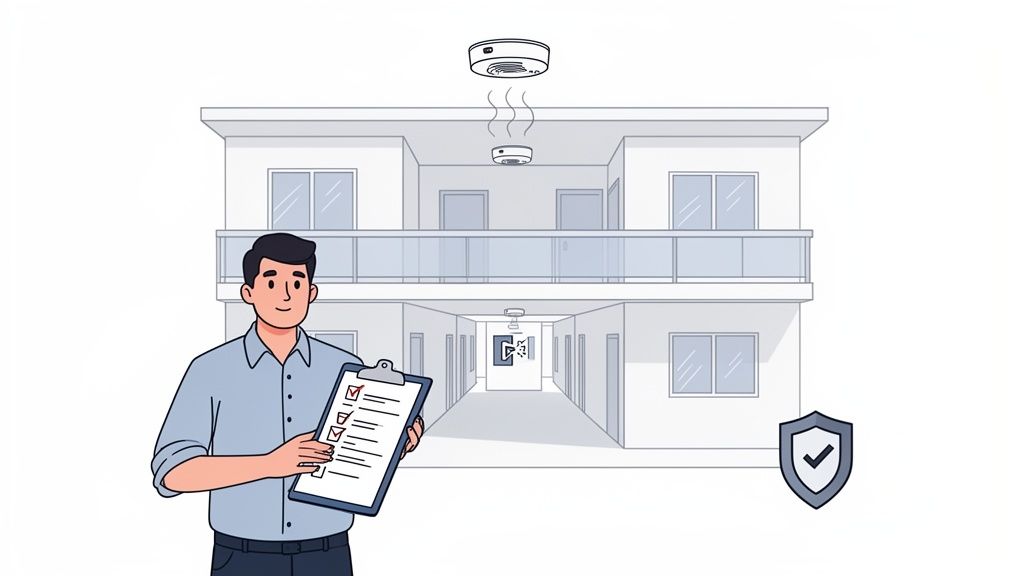
It can feel like a lot to get your head around, but all your fire safety responsibilities boil down to one simple concept: you are the designated ‘Responsible Person’. This is a legal term, and it means the buck stops with you when it comes to keeping your tenants safe from fire.
Think of your duties as building a strong foundation for a secure home. This foundation rests on a few key pillars. If you neglect one, the whole structure could be compromised.
The Pillars of Fire Safety Compliance
Your core responsibilities can be broken down into three fundamental areas. Get these right, and you're well on your way to running a property that's both safe and legally compliant.
- Fire Risk Assessments: This is your starting point. It’s a thorough check of the property to spot potential fire hazards, figure out who is at risk, and decide what safety measures you need to put in place.
- Alarms and Detection: An early warning is absolutely critical in a fire. This means fitting and maintaining the right number of smoke and carbon monoxide alarms in the right places.
- Safe Escape Routes: If a fire does break out, your tenants must be able to get out quickly and safely. It's your job to make sure all escape routes, like hallways and staircases, are kept clear and are properly equipped.
Understanding the Legal Framework
These duties aren't just good practice; they're the law. The main piece of legislation you need to know about is the Regulatory Reform (Fire Safety) Order 2005. This is what establishes the role of the ‘Responsible Person’ and legally requires a fire risk assessment in the common areas of buildings with multiple occupants, like blocks of flats and HMOs.
The point of all this legislation isn’t just to tick boxes. It's about shifting the mindset from reactive to proactive. It encourages landlords to actively manage fire risk, creating a genuinely safe place for people to live.
Ultimately, being proactive is your best strategy. By understanding these fundamental duties, you can turn what feels like a legal burden into a clear, manageable plan. Bringing in professionals for assessments and any necessary work can make this even simpler, giving you peace of mind that you're protecting your tenants and your investment.
The Legal Framework All Landlords Must Know
Trying to get your head around landlord fire safety regulations can feel like wading through alphabet soup. The key is to understand that these laws aren't just a random list of rules; they build on each other to create a complete safety net for your rental property. Seeing how they connect is the first step to getting everything right.
The bedrock of modern fire safety is the Regulatory Reform (Fire Safety) Order 2005. This was a huge shake-up, simplifying a messy tangle of older laws. It swept away around 70 different bits of fire legislation, replacing them with a single, risk-based approach. It also introduced the concept of the ‘Responsible Person’—and for a rental property, that’s almost always you, the landlord.
This Order is particularly focused on the common areas of buildings with multiple homes, like the hallways in blocks of flats or HMOs. It’s what legally requires you to carry out a proper fire risk assessment for these shared spaces.
The Essential Alarm Regulations
Building on that foundation are the Smoke and Carbon Monoxide Alarm (England) Regulations 2015, which got an important update in 2022. These rules are refreshingly straightforward and apply to pretty much every residential landlord out there.
The requirements are clear and non-negotiable:
- You must install at least one smoke alarm on every storey of your property that’s used as living accommodation.
- A carbon monoxide alarm must be fitted in any room with a solid fuel-burning appliance, like a wood burner or an old-school coal fire.
- You’re also responsible for making sure all alarms are working properly at the start of each new tenancy.
The 2022 amendment added a crucial ongoing duty. If a tenant reports a faulty alarm, you are now legally required to repair or replace it "as soon as reasonably practicable." This shifts the responsibility from a simple one-time check to active, ongoing maintenance.
These alarm regulations are just the minimum standard. The London Fire Brigade often goes further, recommending extra heat detectors in kitchens and additional smoke alarms in living rooms and hallways to give tenants the earliest possible warning.
Post-Grenfell Legislative Changes
The tragic Grenfell Tower fire in 2017 was a watershed moment, triggering a major overhaul of building and fire safety. This led to significant new laws that directly affect landlords, especially those with multi-occupancy buildings.
First up was the Fire Safety Act 2021. This piece of legislation didn’t create new rules but instead clarified and expanded the scope of the original 2005 Order. Critically, it confirmed that the Responsible Person's duties cover the building's structure and external walls, including things like balconies and cladding. It also explicitly includes all flat entrance doors in multi-occupied residential buildings. For a deeper dive, check out our guide on the Fire Safety Order 2005 and what it means for you.
Following that, the Fire Safety (England) Regulations 2022 introduced specific new duties for landlords of high-rise residential buildings (defined as being 18 metres or taller, or at least seven storeys). These include providing residents with detailed fire safety instructions and sharing important building information with the local Fire and Rescue Service.
Finally, don't overlook a much older but still vital piece of legislation: the Furniture and Furnishings (Fire) (Safety) Regulations 1988. This law requires any upholstered furniture you provide—sofas, beds, cushions—to meet strict fire resistance standards. Just look for the permanent label that confirms it complies. It’s a critical piece of the puzzle that’s all too easy to forget.
How to Conduct a Fire Risk Assessment
A fire risk assessment is the absolute foundation of your property's safety plan. It’s not just a box-ticking exercise or a document you file away; it's an active process of looking at your property through a safety-first lens. Think of it like a detective investigating a potential crime before it even happens. You are systematically searching for clues—the hazards—to prevent a disaster.
For a simple, single-let property, conducting one yourself is often manageable, but you have to be thorough. When you get into more complex buildings like large HMOs or blocks of flats, bringing in a competent, accredited professional isn't just a good idea; it's essential to make sure nothing gets missed. This one step dictates every other safety measure you'll need to put in place.
Getting this wrong is a huge red flag for the authorities. Recent UK government data paints a startling picture: of 51,020 fire safety audits carried out by Fire and Rescue Services, a massive 42% ended in an unsatisfactory outcome. The most common failure, cited 8,471 times, was an inadequate risk assessment. You can see the full fire prevention and protection statistics on the official government website.
The Five Steps to a Thorough Assessment
The Health and Safety Executive (HSE) lays out a clear, five-step process that gives you a logical framework for any fire risk assessment. Following these stages ensures your review is structured, comprehensive, and hits all the legal requirements.
Here’s a look at how the key landlord fire safety regulations have evolved, from the foundational 2005 Order right through to the latest rules.
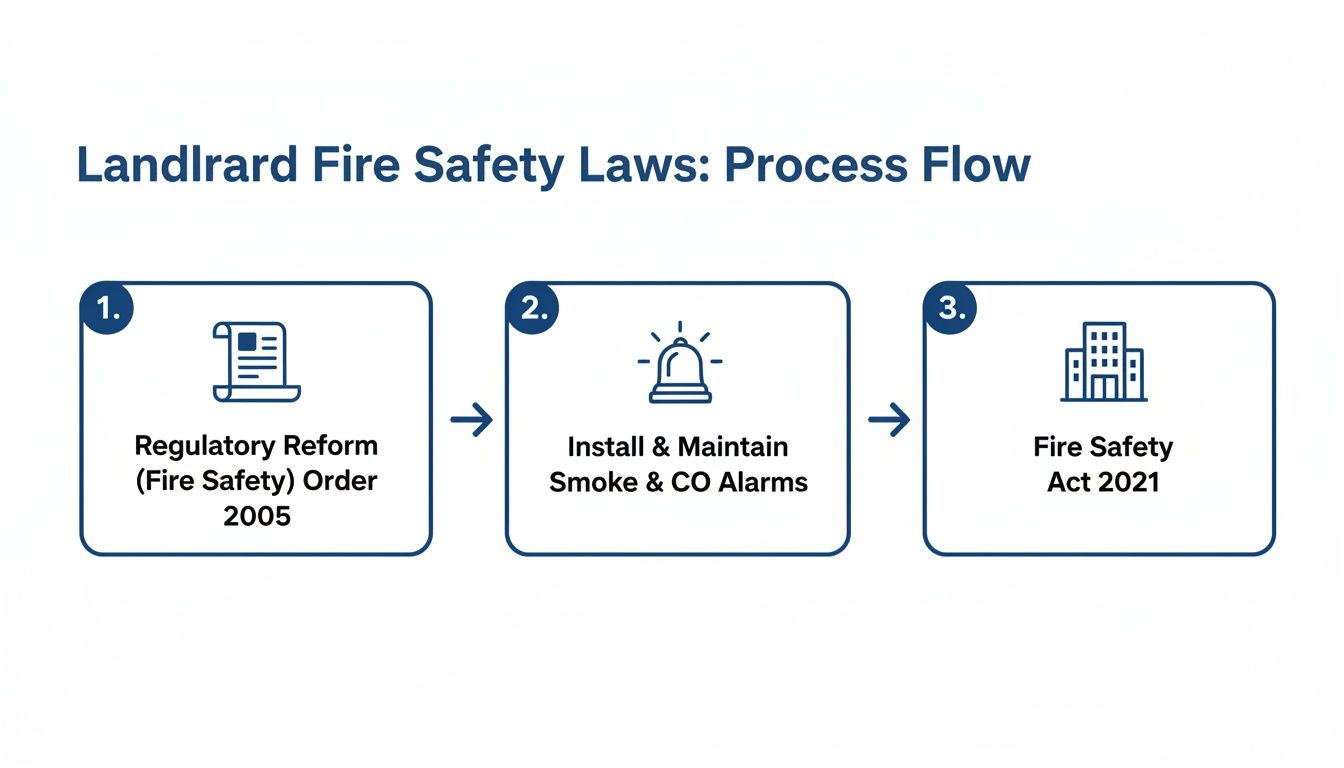
This visual flow shows how each piece of legislation has built upon the last, creating a much stronger safety framework for landlords over time.
To make this practical, the five-step process is the best way to structure your assessment. It breaks a big task down into manageable chunks, making sure you cover all your bases methodically.
| The Five Steps of a Fire Risk Assessment | ||
|---|---|---|
| Step | Action Required | Example for a Rental Property |
| 1. Identify Hazards | Systematically search for potential sources of ignition, fuel, and oxygen. | Checking for frayed electrical wires, overloaded sockets, or clutter in hallways (fuel). |
| 2. Identify People at Risk | Think about everyone who uses the property and their specific vulnerabilities. | Considering tenants with mobility issues, young children, or even guests unfamiliar with the layout. |
| 3. Evaluate & Mitigate Risks | Connect hazards to people and implement measures to remove or reduce the danger. | Replacing a faulty appliance (removing risk) or installing a fire door to slow a fire's spread (reducing risk). |
| 4. Record, Plan & Inform | Document your findings, create a clear emergency plan, and share it. | Writing down the assessment, informing tenants of escape routes, and explaining what to do if an alarm sounds. |
| 5. Review & Update | Treat the assessment as a live document, reviewing it regularly and after any changes. | Re-assessing annually, or immediately after building work or if a new tenant with different needs moves in. |
Following these steps ensures you’ve created a robust, legally compliant assessment that genuinely protects your property and your tenants. Now, let’s break down what each step means in practice.
1. Identify the Fire Hazards
Your first job is to walk through the property and pinpoint anything that could start or fuel a fire.
- Sources of Ignition: Look for potential sparks. This could be anything from faulty wiring and overloaded plug sockets to portable heaters placed too close to curtains or even tenant-owned items like candles.
- Sources of Fuel: What would actually burn? This covers the obvious things like furniture and paper, but also less apparent items like piles of rubbish in a communal area, flammable cleaning liquids, or large amounts of cooking oil stored in a kitchen.
- Sources of Oxygen: While air is everywhere, you should also consider sources that could accelerate a fire, like poorly stored gas canisters for a BBQ on a balcony.
2. Identify People at Risk
Next, you have to consider who would be in danger if a fire broke out. This is more than just a headcount of your tenants.
You need to think about their specific circumstances. Are there young children, elderly tenants, or individuals with mobility issues who might struggle to escape quickly? You also need to factor in guests, visitors, and anyone else who might be on the premises. This step is all about understanding the human element of the risk.
3. Evaluate, Remove, or Reduce the Risks
This is where you connect the dots between the hazards from step one and the people from step two, then decide what to do about it. The goal is to either eliminate the risk completely or, if that’s not possible, reduce it to an acceptable level.
Key Takeaway: Evaluating risk is a practical exercise. If you identified a faulty kitchen appliance (hazard) in a flat with a family (people at risk), the action is clear: repair or replace it immediately. If a communal hallway is cluttered (hazard), you must enforce a clear-routes policy.
This stage is all about implementing control measures. It could mean installing fire doors to compartmentalise a fire, upgrading an old fuse box, or providing tenants with clear guidance on not using extension cords for high-power appliances. You can explore our guide on the specific fire risk assessment requirements for landlords for more detail on this.
4. Record, Plan, and Inform
You are legally required to write down the significant findings of your assessment and the actions you've taken. This record is your proof of compliance. It doesn't need to be overly complicated for a small property, but it must be clear and logical.
Part of this step is creating a straightforward emergency plan. For tenants, this means ensuring they know the escape routes and what to do if they hear a fire alarm. For larger buildings, this involves more detailed plans and instructions posted in visible locations.
5. Review and Update Regularly
A fire risk assessment is a living document, not a one-and-done task. It must be reviewed regularly to make sure it remains accurate and relevant. A good rule of thumb is to review it annually, but you must also update it whenever there's a significant change.
This could be triggered by a change in tenancy (especially if new tenants have different needs), any structural alterations to the property, or even a near-miss incident that highlights a previously unforeseen risk. Keeping your assessment current is a core part of your ongoing duties as a landlord.
Essential Fire Safety Equipment for Your Rental
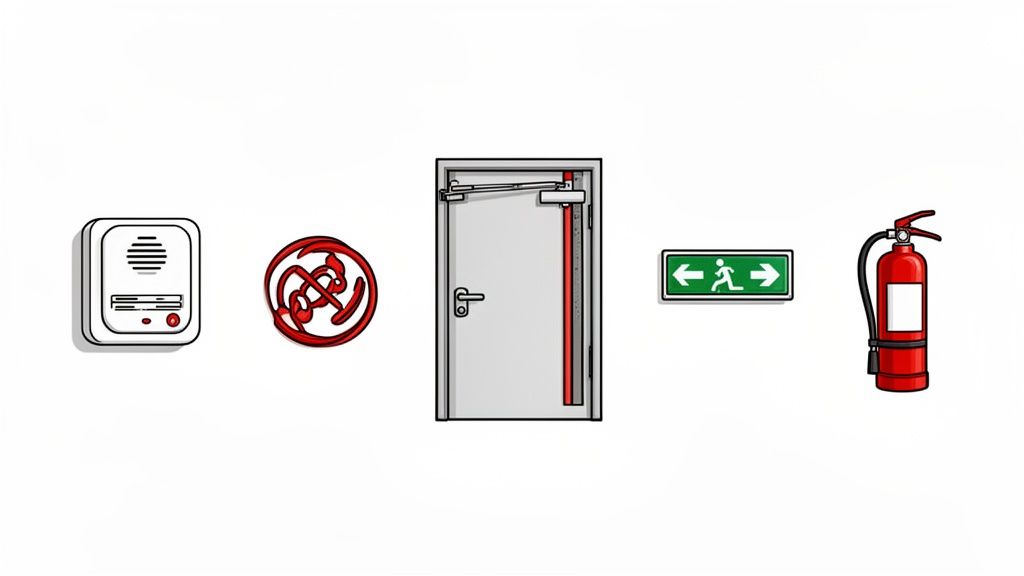
Your fire risk assessment is the blueprint, showing you where the dangers are and who’s at risk. Now, it's time to turn that plan into physical, life-saving equipment. This isn't just about ticking boxes to meet the minimum landlord fire safety regulations; it’s about creating a solid system that gives your tenants the best possible chance if the worst happens.
Think of it like equipping a ship for a safe voyage. You need a reliable warning system (alarms), secure compartments to contain the danger (fire doors), and clear pathways to safety (escape routes). Each bit of kit plays a specific, vital role in the property's overall safety.
Alarms and Detectors: The First Line of Defence
An early warning can be the single most important factor in a fire. The Smoke and Carbon Monoxide Alarm Regulations lay out the absolute minimum, but understanding the nuances is what delivers real protection.
At a basic level, you must install at least one working smoke alarm on every storey of the property that’s used as living space. On top of that, a carbon monoxide alarm is mandatory in any room with a solid fuel-burning appliance, like a log burner.
But not all alarms are created equal. You have two main choices:
- Battery-Powered Alarms: These are simple to install and meet the basic legal requirements. The downside? They rely on tenants to test them and replace batteries, which can easily be a point of failure.
- Mains-Powered Alarms: Hardwired into the property's electricity supply (usually with a battery backup), these are far more reliable. They are a legal requirement in all new-build homes and most Houses in Multiple Occupation (HMOs).
The London Fire Brigade recommends going beyond the bare minimum. They strongly suggest installing an additional heat detector in the kitchen—which is less prone to false alarms from cooking fumes—and putting extra smoke alarms in main living areas and hallways to give the earliest possible warning.
Fire Doors: The Unsung Heroes of Containment
A fire door might look like any other door, but its job is far more important. It’s designed to hold back fire and smoke for a specific period—usually 30 minutes (FD30) or 60 minutes (FD60)—giving people precious time to get out.
A compliant fire door is a complete system, not just a slab of wood. It has to be fitted correctly with several key parts working together.
- Intumescent Strips: Fitted into the door or its frame, these strips expand dramatically when heated. They swell up to seal the gap, stopping smoke and flames from getting through.
- Self-Closing Device: A fire door is useless if it's propped open. A self-closer, whether it’s an overhead device or a concealed one, makes sure the door automatically shuts firmly into its frame every time.
- Certified Core: The door itself must be certified to resist fire for a set duration. You can often find a label or plug on the top edge of the door confirming its rating.
Regular checks are absolutely vital. Make sure the door closes properly from any angle, the intumescent strips are intact, and tenants haven't tampered with the closing mechanism. You can find detailed guidance in our complete fire door inspection checklist for landlords to ensure nothing gets missed.
Fire Extinguishers and Blankets: Targeted Protection
While not legally required in a standard single-let property, providing fire extinguishers and fire blankets is considered best practice. For larger properties and HMOs, however, they become a necessity.
The type of extinguisher really matters, as different ones are designed for different types of fire:
- Water: For paper, wood, and textiles.
- Foam: For flammable liquids like petrol or paint.
- Dry Powder: A versatile option but messy, and it can obscure vision in a panic.
- CO2: Best for electrical fires as it leaves no residue.
- Wet Chemical: Specifically designed for cooking oil and fat fires (like from deep fat fryers).
A fire blanket, usually kept in the kitchen, is a brilliant tool for smothering small pan fires before they can escalate. If you do provide this equipment, you must ensure it's properly maintained and that tenants know where it is and how to use it safely.
Emergency Lighting and Signage: Guiding the Way Out
In the common areas of larger buildings like blocks of flats or complex HMOs, the standard lighting can fail during a fire. This is where emergency lighting becomes crucial. It's a secondary system with its own power source that kicks in automatically during a power cut, lighting up escape routes like corridors and stairwells.
Alongside this, clear signage is essential. Green running-man signs, known as pictogram signs, should be used to clearly mark the way out. These signs must be visible even if the main power fails, either through their own internal light or by being photoluminescent (glow-in-the-dark).
Keeping Escape Routes Clear: A Non-Negotiable Rule
Finally, we have the simplest yet most frequently overlooked piece of the safety puzzle: the escape route itself. A fire door, alarms, and emergency lighting are all useless if the path to safety is blocked.
It is your absolute responsibility to ensure that all escape routes—hallways, landings, and staircases—are kept completely clear of obstructions. That means no tenant belongings like bikes, pushchairs, or boxes can be stored there. This rule must be clearly communicated to all tenants and strictly enforced. A clear escape route costs nothing but is one of the most vital components of your fire safety system.
Special Rules for HMOs and High-Rise Buildings
When it comes to landlord fire safety regulations, it's definitely not a one-size-fits-all situation. The risk of a fire spreading and ripping through multiple households is far higher in properties with shared living spaces or complex layouts. That’s why Houses in Multiple Occupation (HMOs) and high-rise residential buildings are held to a much stricter set of rules.
Think of it like this: a detached bungalow has one family and a couple of obvious escape routes. Simple. But a five-storey HMO or a tower block? That's more like a vertical village. A fire starting in one flat could quickly endanger dozens of other people, making beefed-up safety measures absolutely essential. The law gets this, and it places a much higher duty of care on landlords of these more complicated properties.
The Higher Standards for HMOs
If you manage an HMO, your responsibilities go way beyond the basics required for a standard single-let property. Local councils have the power to enforce extra licensing conditions, and these often demand specific and robust fire safety upgrades.
Common requirements for HMOs often include:
- Advanced Alarm Systems: Forget standard battery-powered smoke alarms; they just won't cut it. HMOs typically need a mains-powered, interlinked alarm system. This means if a detector goes off in the kitchen, it triggers every other alarm in the building, making sure everyone is alerted instantly.
- Certified Fire Doors: You will almost certainly need to fit certified fire doors (usually FD30 rated, meaning they resist fire for 30 minutes) on high-risk rooms like kitchens. Many councils also insist on them for every bedroom door that opens onto an escape route.
- Emergency Lighting: For larger or more complex HMOs, emergency lighting in hallways and stairwells is often mandatory. This is crucial for lighting the way out if the power fails during a fire.
- Firefighting Equipment: Unlike single lets, HMOs must usually have the right fire extinguishers and fire blankets installed in common areas, especially in kitchens where the risk is greatest.
Because these rules can vary quite a bit between different local authorities, it is absolutely crucial to check with your specific council's HMO licensing department. They will tell you the precise standards your property has to meet.
Navigating High-Rise Building Regulations
In the wake of the Grenfell Tower tragedy, the government brought in specific, detailed legislation for landlords and building managers of high-rise residential properties. The Fire Safety (England) Regulations 2022 apply to buildings that are 11 metres or taller and place new, crystal-clear duties on the Responsible Person.
Key duties for these taller buildings include:
- Providing Fire Safety Instructions: You must give residents clear guidance on what to do if there’s a fire. This includes information on evacuation procedures and hammering home the importance of keeping fire doors closed.
- Sharing Information with Fire Services: You have a legal duty to share up-to-date building floor plans and details about the external wall system with your local Fire and Rescue Service. This info has to be kept in a secure information box on-site so firefighters can access it in an emergency.
A huge focus of the post-Grenfell legislation has been on the building's exterior. The Fire Safety Act 2021 made it clear that the building's external wall system—cladding, balconies, and the like—falls squarely under the scope of the fire risk assessment. This means landlords have to assess and manage these risks.
The urgency of this work is stark. A recent report from the Regulator of Social Housing on buildings over 11 metres found that while 99.2% had a fire risk assessment, a worrying 11.5%—that’s over 2,000 buildings—still had life-critical fire safety defects related to their external walls. You can read more about the findings on UK social housing remediation progress.
Maintaining Compliance and Avoiding Common Pitfalls
Keeping on top of landlord fire safety isn't a one-and-done job you can just tick off a list. Think of it less like a final exam and more like a continuous maintenance schedule for a valuable asset. It’s an ongoing commitment that demands constant vigilance to protect both your tenants and your investment.
This proactive mindset starts with meticulous record-keeping. A well-organised file is your best defence, proving you’ve taken your responsibilities seriously. If your compliance is ever questioned, this paperwork is invaluable, acting as a complete safety diary logging every crucial action you’ve taken.
Your Essential Paper Trail
Your records need to be comprehensive and easy to get your hands on. As a bare minimum, your compliance file should contain:
- Updated Fire Risk Assessments: Keep every version. This shows a clear history of reviews and any actions you took as a result.
- Alarm Maintenance Logs: Document every single test, battery change, or repair for your smoke and carbon monoxide alarms.
- Fire Door Inspection Reports: Note the dates and outcomes of regular checks on self-closers, intumescent seals, and their overall condition.
- Service Certificates: File away the certificates for any emergency lighting, fire extinguishers, or mains-wired alarm systems.
Keeping these documents organised not only proves you’re on top of landlord fire safety regulations but also creates a clear, undeniable timeline of your efforts.
Common but Dangerous Landlord Mistakes
Even the most conscientious landlords can fall into bad habits. These seemingly small oversights can create massive risks, completely undermining all your other safety measures. The good news is, the most common pitfalls are often the simplest to avoid.
A propped-open fire door, a cluttered hallway, or a faulty alarm can completely negate thousands of pounds worth of safety investment. Diligence in the small details is what truly keeps tenants safe.
Here are the critical mistakes to watch out for:
- Ignoring Communal Clutter: Bikes, pushchairs, or boxes left in hallways and stairwells can turn a clear escape route into a deadly obstacle course in a smoke-filled emergency. It has to be kept clear, always.
- Neglecting In-Tenancy Checks: Forgetting to test alarms periodically or inspect fire doors between formal assessments allows dangerous faults to go unnoticed for months.
- Allowing Fire Door Tampering: Tenants often wedge fire doors open for convenience, rendering them totally useless. This must be strictly prohibited and regularly checked for.
Make no mistake, the consequences of non-compliance are severe. Authorities can issue enforcement notices, hand out unlimited fines, and in the most serious cases, pursue criminal prosecution that could lead to imprisonment. Staying vigilant isn’t just about dodging penalties; it's about upholding your fundamental duty of care.
Got Questions? We’ve Got Answers
Digging into the details of fire safety rules can often leave you with more questions than when you started. It's completely normal. To help clear things up, here are some straight answers to the questions we hear most often from landlords across England.
How Often Should I Be Checking My Fire Alarms?
Legally, you have to make sure every smoke and carbon monoxide alarm is working on day one of a new tenancy. That’s the bare minimum.
Best practice, and what the fire services strongly push for, is to test them every month. On top of that, the 2022 regulations mean you must fix or replace a faulty alarm as soon as your tenant tells you about it. Don't drag your feet on this one.
Are Fire Extinguishers a Must-Have in My Rental?
For a typical single-family rental, fire extinguishers aren't legally required. That said, putting a small multi-purpose extinguisher and a fire blanket in the kitchen is a smart move that shows you care. It’s good practice.
However, if you’re running a House in Multiple Occupation (HMO), they are absolutely mandatory. You’ll generally need to place at least one suitable extinguisher in the common area of each floor.
Just sticking an extinguisher on the wall isn’t enough. If you provide them in an HMO, you’re also on the hook for getting them serviced annually by someone who knows what they’re doing. An extinguisher that doesn't work is just a red decoration.
What’s My Responsibility for a Tenant’s Furniture?
Your legal duties under the Furniture and Furnishings (Fire) (Safety) Regulations 1988 only cover the items you supply as the landlord. This means things like sofas, beds, cushions, and mattresses you've provided must meet fire resistance standards.
You are not responsible for the furniture your tenants bring with them. If they buy a second-hand sofa that isn't compliant, that's on them, not you.
Can I Ban Tenants from Smoking Inside the Property?
Yes, you certainly can. While no specific law forbids smoking in a standard private rental, you have every right to add a "no smoking" clause to your tenancy agreement.
Honestly, you absolutely should. Discarded cigarettes are still a leading cause of house fires, and a simple clause in your contract is one of the most effective fire prevention tools you have.
Staying on top of landlord fire safety regulations is non-negotiable—it protects your tenants, your investment, and gives you peace of mind. If you need expert help with compliance, remedial works, or professional advice, trust All Well Property Services.
From installing certified fire doors to managing full-scale property renovations, we make sure your property is safe, compliant, and maintained to the highest standard. Get in touch with us today to see how we can help.


