



A loft conversion is the art of turning that empty, dusty space at the top of your house into a proper, liveable room—think a new bedroom, a home office, or a playroom for the kids. It’s one of the most popular ways to improve a home in the UK, especially in London, because it adds serious living space and can really boost your property’s value, all without having to build outwards.
Unlocking Your Home’s Hidden Potential
Think of your attic as a blank canvas. Right now, it’s probably a dark, forgotten space filled with old boxes and suitcases. A loft conversion completely reimagines this area, transforming wasted potential into one of your home's best features. It’s not just about adding another room; it’s about fundamentally changing how your home works for you and your family.
The process involves beefing up the floor, insulating the roof, adding windows to let the light flood in, and fitting a proper staircase. The aim is to create a space that’s just as safe, comfortable, and well-finished as any other room in your house. Instead of going through the hassle and expense of moving, a loft conversion lets you get the space you need, right where you already are.
More Than Just Extra Space
So, what is a loft conversion in practical terms? It’s a smart solution to a very common problem. So many London homeowners find themselves outgrowing their properties but can’t bear the thought of leaving a neighbourhood they love. This is where a loft conversion comes in as a practical, sensible alternative to moving house.
This kind of transformation brings a whole host of benefits:
- Creating a Private Retreat: A master bedroom with an en-suite offers a quiet escape from the rest of the house.
- Designing a Dedicated Workspace: A peaceful, light-filled home office can do wonders for focus and productivity.
- Adding a Family Hub: A playroom for the kids or a den for teenagers helps contain the clutter and gives everyone their own zone.
- Boosting Property Value: Studies have consistently shown that a well-done loft conversion can add up to 24% to your home’s value—a fantastic return on your investment.
A loft conversion is about reclaiming unused space to make your lifestyle better. It turns a forgotten attic from a simple storage dump into a vibrant, essential part of your home, perfectly suited to whatever your family needs.
Ultimately, converting your loft is about unlocking your property’s full potential. It’s a strategic home improvement that gives you immediate lifestyle benefits and long-term financial gains, making it a particularly smart move for homeowners in the competitive London property market.
Exploring the Four Main Types of Loft Conversion
Once you've decided a loft conversion is the right move for your home, the next question is always: which type? Think of it like buying a car. You wouldn’t pick a two-seater sports car for a family of five, and the same logic applies here. The best choice depends entirely on your property’s style, your budget, and exactly what you want to do with the new space.
Each approach involves a different level of structural work, and each comes with its own set of pros and cons. Getting your head around these options is the key to unlocking your attic’s true potential. Let’s break down the four main types you’ll come across, especially here in London.
Rooflight or Velux Conversions
This is the simplest and most budget-friendly way to get a room in the roof. A Rooflight conversion, often just called a Velux conversion after the famous window brand, involves the least amount of structural fuss. You’re essentially keeping the existing shape of your roof and just slotting windows in that sit flush with the roofline.
The work involves strengthening the floor, adding all the necessary insulation, and then fitting out the inside with plasterboard, electrics, and plumbing. Because you’re not really changing the roof structure, the project is much quicker and causes far less disruption.
- Best for: Homes that already have decent head height in the loft (you’ll need at least 2.2 metres) and for anyone working with a tighter budget.
- Space created: The usable space is defined by your existing roof’s dimensions and pitch.
- Key benefit: Minimal structural changes mean it’s the cheapest and fastest option to complete.
Dormer Conversions
The Dormer conversion is, without a doubt, the most popular choice for homeowners right across the UK. It involves building a box-shaped structure that juts out vertically from the slope of your roof. This simple addition creates a flat ceiling and straight walls inside, which massively increases the usable floor area and headroom.
Dormers come in all shapes and sizes, from a small single one to a huge flat-roofed structure that runs the full width of the house. This flexibility makes them a great fit for almost any property, including London’s classic Victorian and Edwardian terraces.
By pushing the roof outwards, a dormer doesn’t just add a bit of space—it completely transforms the feel of the room. Those awkward attic slopes are replaced with proper vertical walls and a high, flat ceiling. It stops feeling like an attic and starts feeling like a normal, functional room.
This extra vertical wall is perfect for a large window or even French doors with a Juliet balcony, flooding the space with natural light and opening up some pretty impressive views.
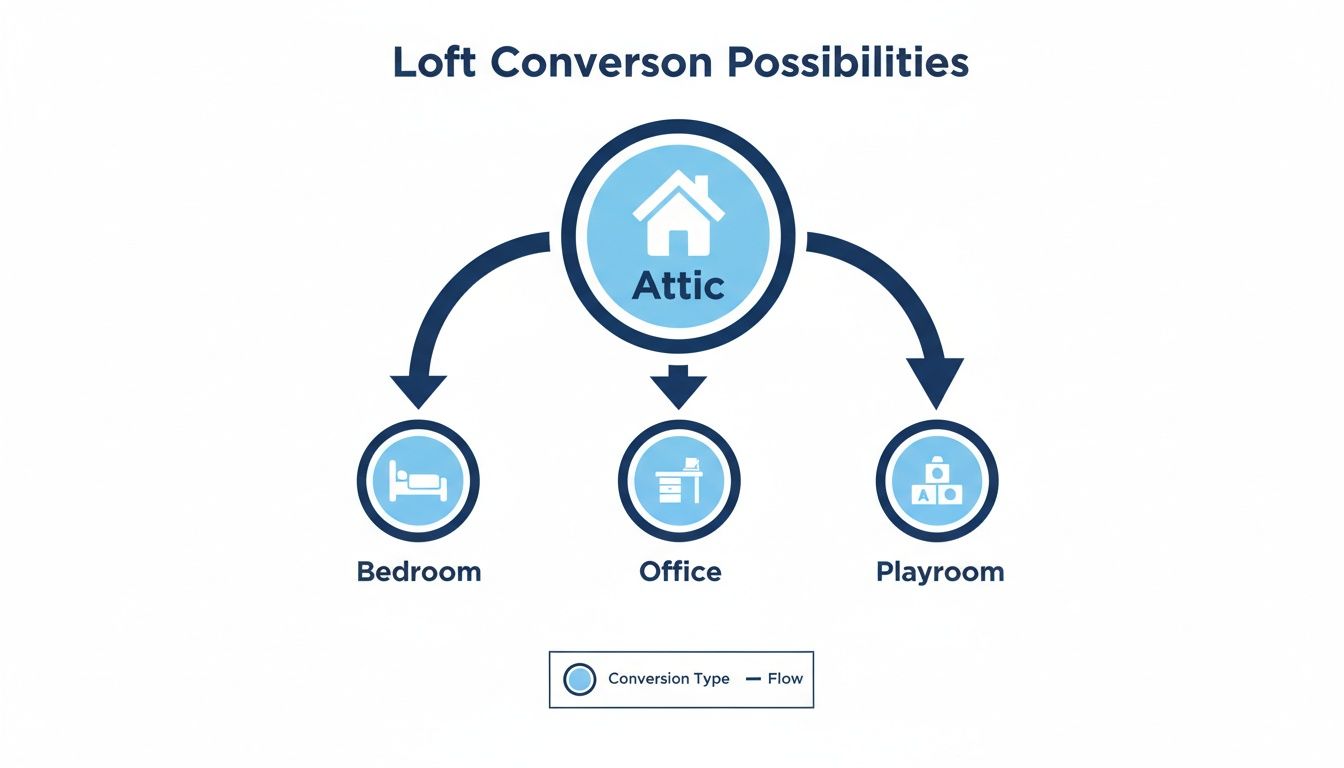

As the diagram shows, a single, dusty attic holds the potential to become a valuable new bedroom, a quiet home office, or a much-needed playroom for the kids.
Comparing Loft Conversion Types At a Glance
To make things a bit clearer, here’s a quick rundown of the four main types. This should help you see how they stack up against each other and figure out which one might be the best fit for your London home.
| Conversion Type | Best For | Typical Cost Range (London) | Planning Permission Needed? | Key Benefit |
|---|---|---|---|---|
| Rooflight/Velux | Homes with existing high ceilings; budget-conscious projects. | £25,000 – £40,000 | Rarely | Lowest cost and fastest completion. |
| Dormer | Most terraced & semi-detached homes; maximising headroom. | £45,000 – £70,000 | Sometimes | Creates a practical, box-shaped room. |
| Hip-to-Gable | Semi-detached & end-of-terrace homes with hipped roofs. | £55,000 – £80,000 | Often | Turns a small, hipped roof into a large, usable space. |
| Mansard | Maximum space creation, especially in conservation areas. | £60,000 – £90,000+ | Almost always | Adds what feels like an entire new storey to the house. |
This table gives you a starting point, but the right choice always comes down to the specifics of your property and your own priorities.
Hip-to-Gable Conversions
If you live in a semi-detached or end-of-terrace house with a hipped roof (that’s where the roof slopes inwards on three sides), a Hip-to-Gable conversion is usually the perfect solution. This project involves getting rid of one of the sloping ‘hips’ and building it up into a vertical brick wall, called a gable end.
This new wall extends straight up to meet the roof ridge, creating a much bigger internal space. To get the most out of it, this is often combined with a dormer on the back of the property.
- Best for: Semi-detached, end-of-terrace, or detached properties that have a hipped roofline.
- Space created: A huge increase in usable floor area and headroom, especially when you add a rear dormer into the mix.
- Key benefit: It transforms a cramped, awkwardly shaped attic into a spacious, rectangular room that’s dead easy to furnish.
Mansard Conversions
If you’re after the absolute maximum amount of space you can get, a Mansard conversion is the biggest and most transformative option out there. Named after the 17th-century French architect François Mansart, this type of conversion pretty much rebuilds your roof.
The process involves raising the party walls on both sides of your property and creating a new roof structure with a flat top and a very steep back slope, set at 72 degrees. This near-vertical slope usually has dormer windows built into it and is clad with tiles.
Because it’s such a major structural job, a Mansard is the most expensive option and will almost certainly require planning permission. The pay-off, though, is a full-floor extension that feels like a natural part of the house, not just a converted attic. You can find out more about the differences in our in-depth guide to loft conversion types explained. They’re especially common on older terraced houses in London, where they add a huge amount of high-value living space.
Is Your London Property Suitable for a Loft Conversion?
Before you start pinning pictures of en-suite bathrooms and skyline views, it’s worth checking if your property is actually a good candidate for a loft conversion. Not every attic has what it takes. The good news? Many London homes, especially the classic Victorian and Edwardian terraces, are almost perfectly designed for this kind of transformation.
The whole process starts with a few simple checks you can do yourself. These initial measurements and a quick look around will tell you if your loft has the fundamental structure needed to become a beautiful, functional living space.
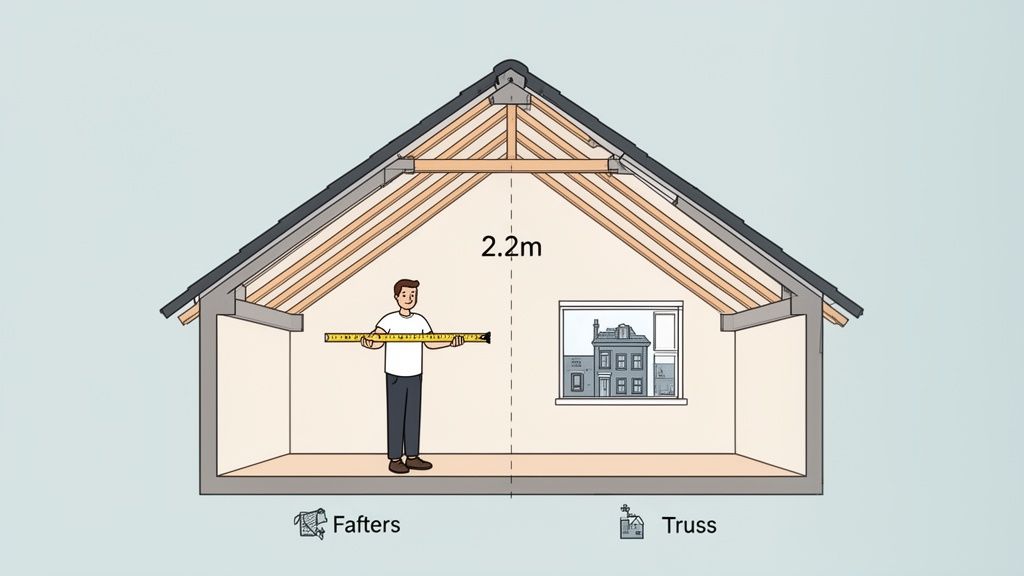

The Crucial Head Height Test
The single most important factor is head height. Without enough vertical space, creating a comfortable and legally compliant room is pretty much impossible. You need enough clearance not just for walking around, but also to accommodate the new floor structure and all the insulation that goes with it.
To pass the test, you need a minimum of 2.2 metres (or about 7 feet 2 inches) at the highest point of your attic. This measurement is taken from the top of the existing ceiling joists to the bottom of the ridge board—that's the main timber beam at the very peak of the roof.
You can easily measure this yourself. Grab a tape measure, pop your head into the loft, and measure from the floor joists straight up to the highest point. If you’ve got 2.2m or more, you’re very likely in a good position to move forward.
If you're a little short, don't panic just yet. It doesn't automatically rule you out, but it might mean more complex and costly structural work, like lowering the ceilings of the rooms below.
Understanding Your Roof Structure
Next up, you need to have a peek at how your roof is actually built. Most UK homes have one of two types of roof structure, and one is far easier to convert than the other.
- Traditional Rafters: Found in most homes built before the 1960s, these roofs have rafters that run along the edges, leaving a large, open space in the middle. This is the ideal scenario for a loft conversion because the space is already mostly clear. It's what you're hoping to see.
- Modern Trusses: Homes built from the 1960s onwards often use factory-made trussed roofs. These have distinctive W-shaped timber struts that provide support but fill up the entire attic space. Converting a trussed roof is still possible, but it requires significant structural engineering to replace the support system, making it a more complex and expensive job.
Other Key Suitability Factors
Beyond height and structure, a few other things come into play. Take a quick look around your attic for any potential complications that could throw a spanner in the works.
- Roof Pitch: A steeper roof pitch naturally creates more central head height and usable floor space. A shallow pitch might limit your options or make a dormer conversion essential just to create the headroom you need.
- Obstacles: Are there large water tanks or chimney stacks running through the space? These can usually be moved or worked around, but they will add to the complexity and cost of the project.
- Staircase Location: You'll need a proper, permanent staircase, and it must comply with Building Regulations. A good designer will find a logical spot for it, often above your existing staircase, to make sure it doesn’t gobble up valuable floor space on the level below.
Thankfully, many older properties in London, particularly Victorian and Edwardian houses, tick all the right boxes with their traditionally framed, steeply pitched roofs. This inherent suitability is a key reason what is a loft conversion has become such a hot topic among the city’s homeowners looking to expand their living space.
Getting to Grips with Planning Permission and Building Regulations

Once you’re confident your house is a good candidate, it’s time to tackle the legal side of things. This part can sound a bit daunting, but it’s actually pretty logical once you get your head around it. Every loft conversion has to clear two separate hurdles: Planning Permission and Building Regulations.
Think of them like this: Planning Permission is all about how your home looks from the outside and how it affects your neighbours and the street. Building Regulations, on the other hand, couldn’t care less about aesthetics; they are laser-focused on the safety and structural soundness of the work. They’re there to make sure your new room is safe, healthy, and energy-efficient.
The Good News: You Might Not Need Planning Permission
Here’s where things get interesting for a lot of homeowners. You might be able to skip the whole planning permission process entirely. Thanks to something called Permitted Development (PD) rights, a huge number of loft conversions can go ahead without needing a formal application, as long as they stick to some very specific rules.
This is a massive plus. It saves you time, endless paperwork, and application fees. To stay within your PD rights, your conversion must follow a few key limits:
- The new volume you add can’t be more than 40 cubic metres for a terraced house.
- For detached and semi-detached homes, that limit goes up to 50 cubic metres.
- The extension can’t pop up higher than the highest point of your existing roof.
- No verandas, balconies, or raised platforms are allowed.
You can think of Permitted Development as a pre-approved pass for common home improvements. As long as your plans fit neatly within the government's set boundaries, you can get started without asking the local council for specific permission, which really simplifies things.
It's no surprise that loft conversions are more popular than ever, partly because these rights make them so much more accessible. With housing shortages pushing people to improve rather than move, one recent study found that 46% of UK homeowners are planning major improvements by 2025, and loft extensions are high on that list. You can read the full research on 2025 loft conversion cost trends and statistics on westonconstruction.co.uk.
When You Will Definitely Need Planning Permission
Permitted Development rights aren't a free-for-all, though. You will almost certainly need to submit a full planning application if your home sits in a specially designated area, like a Conservation Area, a National Park, or an Area of Outstanding Natural Beauty. These places have much tighter rules to protect their unique character.
You’ll also need to go through the formal application process if your design plans are bigger than the PD limits allow—a large Mansard conversion, for instance, will nearly always need it. Our guide offers more detail on how to handle loft conversion planning permission.
Building Regulations: The Non-Negotiable Bit
So, while you might be able to sidestep planning permission, Building Regulations are mandatory for every single loft conversion. There are absolutely no exceptions. These are the national standards that are there to protect you, ensuring your new space is safe, strong, and actually liveable. A building control officer will need to pop in to inspect the work at key stages before signing it off.
Here’s what they’ll be looking at:
- Structural Strength: Checking the existing floor joists can handle the extra weight and that all the new structural bits are installed correctly.
- Fire Safety: This is a big one. It covers fitting mains-powered smoke alarms, making sure doors are fire-resistant, and having a safe escape route.
- Staircase Design: The new stairs have to be designed safely, with enough headroom and proper handrails.
- Insulation: The rules lay out exactly how much thermal, sound, and energy insulation is needed to stop heat loss and cut down on noise.
One last thing—if your property shares a wall with a neighbour, you’ll also have to follow the Party Wall Act 1996. This just means you have to formally let your neighbours know about the work you’re planning. It’s a legal step designed to stop any disputes before they start.
How Much Does a London Loft Conversion Cost?
Let’s talk numbers. Figuring out the financial side of a loft conversion is easily one of the most important first steps. In a city like London, where every square metre counts, the cost isn't just about the building work—it's a direct reflection of the serious value you’re adding to your property. The final bill is always a mix of the conversion type you choose, the size of your home, and the level of finish you're after.
Think of it like buying a car. A basic, reliable model will get you from A to B, much like a simple Rooflight conversion. But if you want a high-performance model with all the luxury extras, the price tag will be completely different—that’s your complex Mansard conversion. Your project will fall somewhere on that spectrum.
Typical London Cost Brackets
While no two projects are ever identical, it helps to have some ballpark figures in mind. For 2025, a standard loft conversion in the UK generally sits between £30,000 and £75,000. But let's be realistic—for homes in sought-after London postcodes like Fulham, Kensington, or Clapham, you should definitely budget towards the higher end of that scale.
Here’s a rough guide to what you can expect to invest in the capital:
- Velux/Rooflight Conversion: Usually the most straightforward, starting from £25,000 to £35,000.
- Dormer Conversion: A popular choice, typically ranging from £35,000 to £55,000.
- Hip-to-Gable Conversion: A bit more involved, costs are around £45,000 to £65,000.
- Mansard Conversion: The most complex and spacious, often starting above £60,000 and can climb to £85,000+.
What Does a Quote Usually Include?
A proper, fixed-price quote from a reputable firm should cover everything needed to hand over a finished, liveable space. Getting this clarity upfront is vital to avoid any nasty financial surprises later on.
A fixed-price quote isn't just a number; it's a promise. It gives you peace of mind by clearly laying out the scope of work, ensuring the price you agree is the price you pay for the specified job. It’s your protection against unexpected cost hikes.
A standard quote will almost always cover:
- Design and Structural Engineering: All the architectural plans and crucial structural calculations.
- Core Construction: The main structural work, including reinforcing the floor, new timbers, and insulation.
- External Finishes: All the roofing, windows, and any cladding needed to make it weatherproof.
- Internal Basics: Plastering, first-fix electrics, basic plumbing, and fitting the new staircase.
What’s often budgeted for separately are the high-end finishes. These "extras" are where you get to personalise the space to your taste—things like luxury bathroom suites, bespoke built-in wardrobes, or premium flooring. For a more personalised estimate, check out our loft conversion cost calculator to help budget for your project.
Project Timelines From Design to Completion
It’s not just about the money; having a realistic timeline is just as important. A well-run project follows a clear path. The initial design and planning stage—which covers architectural drawings and getting any necessary approvals—usually takes about 2 to 3 months.
Once all the paperwork is sorted and the scaffolding goes up, the build phase itself is surprisingly quick. For most standard loft conversions, you can expect the actual construction work to take between 8 and 12 weeks from start to finish.
The Real Benefits of Converting Your Loft
Thinking about a loft conversion is about more than just getting an extra room. It's a smart investment, both for your property’s value and for your day-to-day life. The instant win is obviously more space, but the real payoff comes from the long-term financial and lifestyle perks. In many cases, it's a much shrewder and more efficient move than a ground-floor extension.
The biggest hook for most homeowners? The financial return. A well-designed loft conversion doesn't just pay for itself; it can turn a tidy profit. This is especially true in a place like London, where every square foot of space is gold dust.
A Powerful Return on Investment
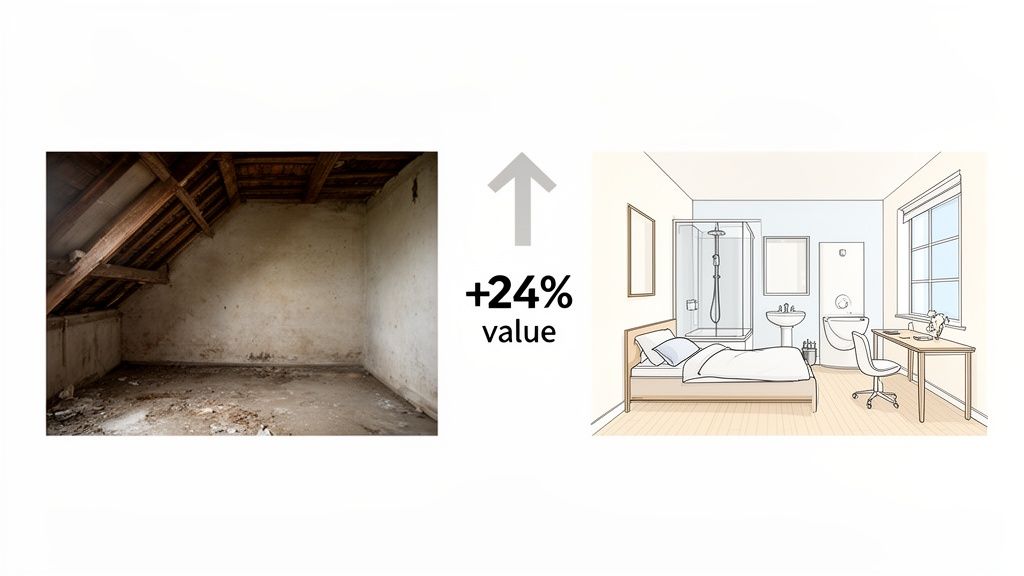
Let's talk numbers, because this is where a loft conversion really shines. Research shows that adding a double bedroom and a bathroom in the loft can boost the value of a three-bedroom house by up to 24%. For a typical £400,000 London home, that’s a potential jump of £80,000 to £96,000—often far more than what the project costs in the first place. You can find more detail on loft conversion value on nuloft.co.uk.
And the best part? You get all this financial gain without giving up an inch of your precious garden. For plenty of London families, keeping that outdoor space is a deal-breaker, which makes building up, not out, the perfect solution.
Enhancing Your Everyday Lifestyle
The value isn’t just in pounds and pence. A new loft room can completely change how your family uses your home, making it fit your life as it changes.
A loft conversion is about reclaiming unused space to make your lifestyle better. It’s a chance to create a dedicated zone that solves a specific need, whether that's for privacy, productivity, or play.
Just think about what that new top-floor space could become:
- A Private Master Suite: Imagine a peaceful retreat away from the noise and chaos of the main house, complete with its own en-suite and views across the rooftops.
- A Dedicated Home Office: A quiet, light-filled workspace that’s properly separate from your living areas. It's a game-changer for getting a healthier work-life balance.
- A Children’s Playroom or Teenager’s Den: Give the kids their own floor to play, study, or hang out with friends, keeping all their clutter contained and out of your way.
Ultimately, converting your loft gives you a double win. It’s a financially savvy move that pumps up your home's market value while delivering real, immediate improvements to your quality of life.
Choosing the Right Partner for Your Project
A loft conversion is a big deal, but with the right team, it stops feeling like a daunting construction job and turns into an exciting, well-managed journey. Figuring out what a loft conversion is is the first step; picking the right people to build it is the most important one. An experienced team doesn't just stick a room in your roof—they guide you through a process they’ve refined over years, making the whole thing smooth and predictable, from the first sketch to the day they hand you the keys.
The whole project can be broken down into a handful of clear, logical stages. This structured approach, handled by your contractor, takes all the guesswork out of it and gives you a clear roadmap, so you know every detail is being handled properly.
Your Journey From Start to Finish
A full-service contractor takes the whole messy process off your hands, managing every stage with genuine expertise and keeping you in the loop. This is what that journey looks like when you work with a team you can trust.
1. Initial Consultation and Feasibility Check
It all starts with a chat. One of our experts will pop round to your home, measure the head height, take a look at your roof structure, and talk through what you’re hoping to achieve. This is the crucial first step to confirm your property is actually suitable and to get a real sense of your space’s potential.
2. Architectural Design and Planning
Next up, the architects get to work turning your vision into a set of detailed plans. They’ll design a layout that makes the most of every inch of space and light, all while making sure the new structure ticks every box for Building Regulations. If your project needs it, they’ll also handle the Planning Permission application for you.
3. Fixed Quote and Detailed Schedule
Once the design is locked in, you should receive a completely transparent, fixed-price quote. This document breaks down every single cost, so you know exactly what you’re paying for with no nasty surprises down the line. You’ll also get a detailed schedule of works, showing what’s happening and when.
A fixed-price quote isn't just a number; it's a promise. It gives you peace of mind by clearly laying out the scope of work, ensuring the price you agree is the price you pay for the specified job. It’s your protection against unexpected cost hikes.
4. Professional Construction and Project Management
With the plans approved, the build begins. A dedicated project manager takes over, overseeing the entire construction phase. They coordinate all the certified tradespeople, from structural engineers to electricians and plumbers. They make sure the site is kept tidy, the work is top-notch, and you get regular updates on progress. This hands-on management keeps the disruption to your daily life to an absolute minimum.
5. Finishing Touches and Final Handover
This is the final stage, where the space really comes to life. Decorators, tilers, and joiners add all the finishing touches, from painting the walls to fitting out your new en-suite bathroom. After a final inspection and a professional clean, the project is officially signed off, and your stunning new loft is ready for you to move in and enjoy.
Choosing an insured, professional team that understands the unique character of London properties—especially Victorian and Edwardian homes—is vital. The right partner doesn't just guarantee a beautiful result, but a stress-free process that adds real, lasting value to your home.
Your home is your most valuable asset, and a loft conversion is a significant investment in its future. At All Well Property Services, we provide a fully managed, professional service that turns your vision into a reality with minimal disruption and maximum quality.
Ready to unlock your home's hidden potential? Contact us today for a no-obligation consultation and let's discuss how we can create the perfect new space for you.