


Fire doors are a critical, yet often overlooked, component of a building's fire safety strategy. In a city as dense as London, from historic Victorian terraces to modern commercial blocks, a correctly functioning fire door can be the difference between a contained incident and a catastrophe. It is not just about ticking a box for compliance; it is about actively protecting lives, property, and livelihoods.
A faulty fire door is effectively just a standard door, offering little to no resistance against the spread of fire and toxic smoke. For landlords, housing associations, and commercial property managers, regular and thorough checks are a legal necessity under the Regulatory Reform (Fire Safety) Order 2005. For homeowners, especially in shared buildings or period conversions, it is a fundamental aspect of personal and neighbourly safety. However, knowing exactly what to look for can be daunting.
This comprehensive fire door inspection checklist breaks down the seven crucial areas you must assess. It provides actionable steps, UK-specific guidance, and real-world examples to empower you to maintain these life-saving assets effectively. We will cover everything from the structural integrity of the frame and the functionality of the self-closing mechanism to the condition of intumescent seals and the fine print of certification labelling. By following this guide, you will be fully equipped to identify common faults, meet your legal responsibilities, and ensure your fire doors perform as intended when it matters most.
1. Door Frame and Condition Assessment
The first and most fundamental step in any fire door inspection checklist is a thorough assessment of the door frame itself. A fire door is only as effective as its frame; the two components work together as a complete assembly to hold back fire and smoke. This inspection involves a detailed visual and tactile check of the frame’s structural integrity, ensuring it is free from damage, correctly installed, and capable of supporting the door during a fire.
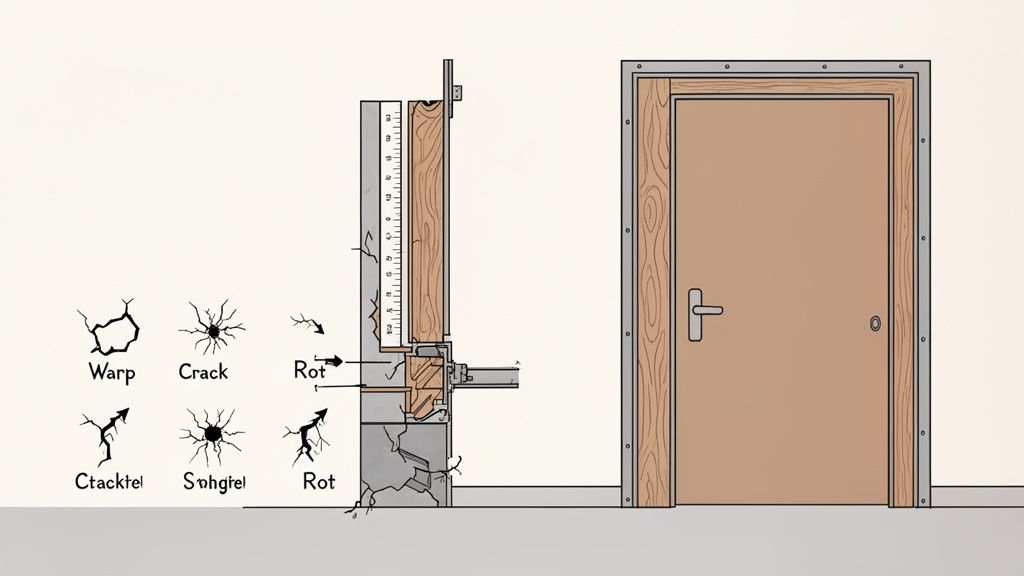

The primary goal is to identify any defects that could compromise the frame's ability to resist fire. This includes looking for cracks, splits, warping, or signs of rot in wooden frames, and checking for corrosion, dents, or distortion in metal frames. The frame must be securely fixed to the surrounding wall with no signs of movement, as any instability could lead to failure under pressure.
What to Look For
A meticulous frame assessment is critical, particularly in London’s diverse building stock, from modern commercial blocks to period residential properties.
- Structural Damage: Visually inspect the entire frame for any signs of physical damage. Look closely for deep cracks in timber frames, which can weaken the structure, or significant dents in steel frames that could prevent the door from closing flush.
- Warping and Alignment: Check that the frame is perfectly square and not warped. A misaligned frame will create inconsistent gaps around the door leaf, allowing smoke and hot gases to pass through.
- Signs of Rot or Corrosion: In older buildings, especially Victorian or Edwardian properties with potential damp issues, check wooden frames for soft spots or discolouration indicating rot. For metal frames, look for rust or corrosion, particularly at the base where moisture can collect.
- Secure Fixings: Gently apply pressure to different parts of the frame to test its stability. It should feel solid and firmly attached to the wall structure. Loose fixings are a major failure point.
Key Insight: A fire door frame is not just a decorative surround; it is an engineered component of the building's passive fire protection system. Its condition is integral to the overall fire compartmentation strategy, a concept you can explore further in this detailed guide to conducting a fire compartmentation survey.
Actionable Tips for Frame Assessment
To ensure your assessment is comprehensive, follow these practical steps:
- Document with Photographs: Before any work begins, take clear photos of the frame from multiple angles. This creates a visual record of its condition, which is invaluable for record-keeping and for discussions with certified inspectors or contractors.
- Consult Specialists for Heritage Properties: If you are managing a period property, avoid making assumptions. Original frames may be protected. Consult a conservation specialist before deciding to replace or significantly alter a historic frame to ensure compliance with both fire safety and heritage regulations.
- Measure Frame Depth: Ensure the frame's rebate (the groove the door sits in) is deep enough for the fire door's thickness. An FD30 door, for example, requires a frame that can properly accommodate it and any intumescent seals without obstruction.
2. Door Leaf, Vision Panels and Glazing – Integrity and Inspection
Following the frame assessment, the next critical step in a fire door inspection checklist is a detailed examination of the door leaf itself, including any vision panels or glazing. The door leaf is the main slab that swings to close the opening, and its integrity is paramount. It must be solid, undamaged, and verified as a certified fire-rated product, as any compromise to its structure can lead to catastrophic failure during a fire.
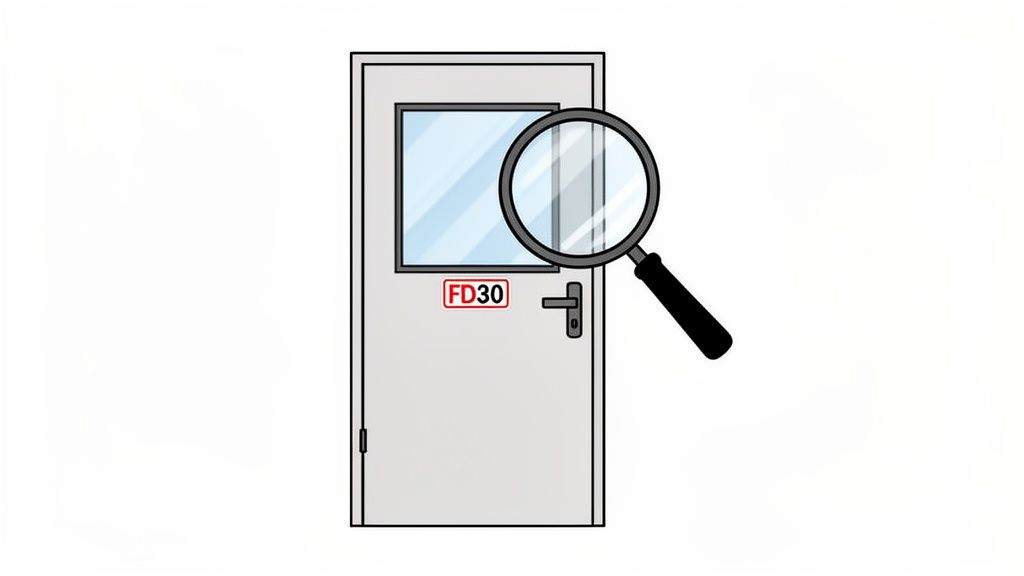
The inspection involves checking for any physical damage, unauthorised modifications, and ensuring all components, especially glazing, are appropriate for the door's fire rating. Holes, deep scratches, delamination, or poorly fitted hardware can create weak points where fire and smoke can penetrate. Any glazing must be fire-rated glass, correctly installed with appropriate seals, as standard glass will shatter almost immediately when exposed to high temperatures.
What to Look For
A thorough inspection of the door leaf is essential, especially in high-traffic environments like London’s commercial offices, healthcare facilities, or residential HMOs where wear and tear is common.
- Surface Damage: Inspect both faces and all four edges of the door leaf for cracks, splits, delamination, or holes. Unauthorised additions like non-fire-rated letterboxes or spy holes are immediate red flags.
- Glazing Integrity: If vision panels are present, check the glass for any cracks, chips, or cloudiness. The glazing beads or astragal bars holding the glass in place must be secure, undamaged, and correctly fitted.
- Certification Labels: Look for a label or plug, typically on the top or hinge edge of the door, indicating its fire rating (e.g., FD30, FD60). The absence of a label may mean the door is not a certified fire door.
- Structural Soundness: Gently tap the door surface; a solid core fire door should produce a consistent, solid sound. A hollow or varied sound could indicate internal damage or that it is not a fire door at all.
Key Insight: A fire door is a tested and certified assembly. Any modification, from drilling a hole for a new lock to adding a vision panel, voids its certification unless carried out by a certified professional using approved components. The door leaf and its glazing must be treated as an integrated system.
Actionable Tips for Leaf and Glazing Assessment
Use these practical steps to conduct a comprehensive inspection:
- Verify Glazing Certification: If the door has a vision panel, do not assume it is correct. Check the door’s certification documents or look for a small etched mark on the corner of the glass (e.g., BS 476: Part 22) that confirms its fire-resisting properties.
- Inspect Seals and Beads: Examine the intumescent glazing seals around the glass. They should be in perfect condition, not painted over or damaged. The beads holding the glass must be tight and secure, with no gaps.
- Document All Modifications: Photograph any non-standard additions, such as pet flaps, vents, or additional locks. These are common failure points and must be addressed by replacing the entire door leaf with a compliant one.
3. Door Closer and Self-Closing Mechanism Functionality
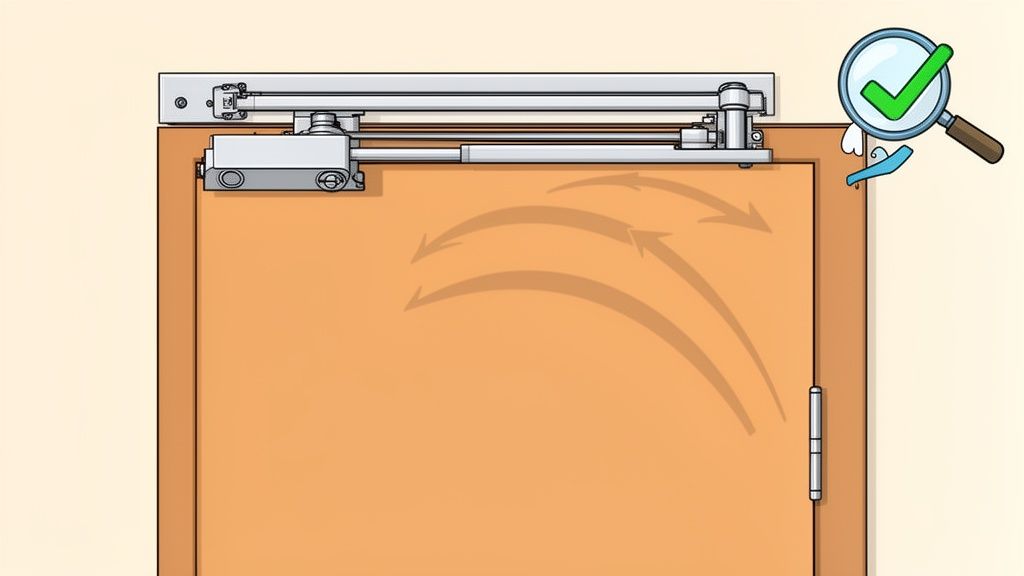
A fire door's ability to self-close is non-negotiable; it is the core function that enables it to contain fire and smoke. This critical action is managed by the door closer, a mechanical or hydraulic device that automatically closes the door from any open position. A thorough inspection of this mechanism ensures it operates reliably, with the correct speed and force, to fully latch the door without slamming, forming a complete seal within the frame.
The primary goal is to verify that the closer is correctly specified for the door's weight and size, is properly adjusted, and is free from defects. A malfunctioning closer, whether it closes too slowly, too forcefully, or not at all, renders the fire door ineffective. This is a common failure point identified during fire door inspections, often due to wear and tear, incorrect installation, or lack of maintenance.
What to Look For
From high-traffic London office blocks to residential apartment buildings, door closers are subjected to constant use, making their regular assessment essential.
- Complete Closure: The door must close fully from any angle and overcome the resistance of the latch mechanism to engage securely in the frame. There should be an audible click as the latch engages.
- Controlled Speed: The door should not slam shut, which can cause injury or damage the door, nor should it close so slowly that it allows significant smoke to pass. The closing action should be smooth and controlled throughout its arc.
- Signs of Hydraulic Failure: Check the closer body and arms for any signs of oil leakage. Oily residue or stains on the closer, door, or floor below are clear indicators of a failed internal seal, which means the device must be replaced.
- Component Integrity: Ensure all parts of the closer are present and secure, including the arm, brackets, and all fixing screws. Missing screws or a detached arm will prevent the device from functioning correctly.
Key Insight: The self-closing device is the engine of the fire door assembly. If it fails, the door is merely a passive barrier. In many commercial settings, door closers are tested quarterly as part of fire safety compliance, a best practice for all managed properties.
Actionable Tips for Closer Assessment
To ensure your door closer assessment is robust, integrate these practical steps into your fire door inspection checklist:
- Test from Multiple Positions: Do not just test the door from a fully open position. Open it to approximately 75mm and release it; it should still close and latch. Then, test from 45 degrees, 90 degrees, and fully open to confirm consistent performance.
- Verify Latching Action: Listen for the "click" of the latch engaging with the strike plate. If the door closes but does not latch, it has failed the test as it will not hold back smoke or pressure from a fire. This may indicate a closer adjustment issue or a problem with frame alignment.
- Check for Obstructions: Ensure that floor coverings, doorstops, or stored items do not impede the door's closing path. Fire doors must never be propped open with unapproved devices like wedges or fire extinguishers.

4. Intumescent Seals and Smoke Seals Inspection
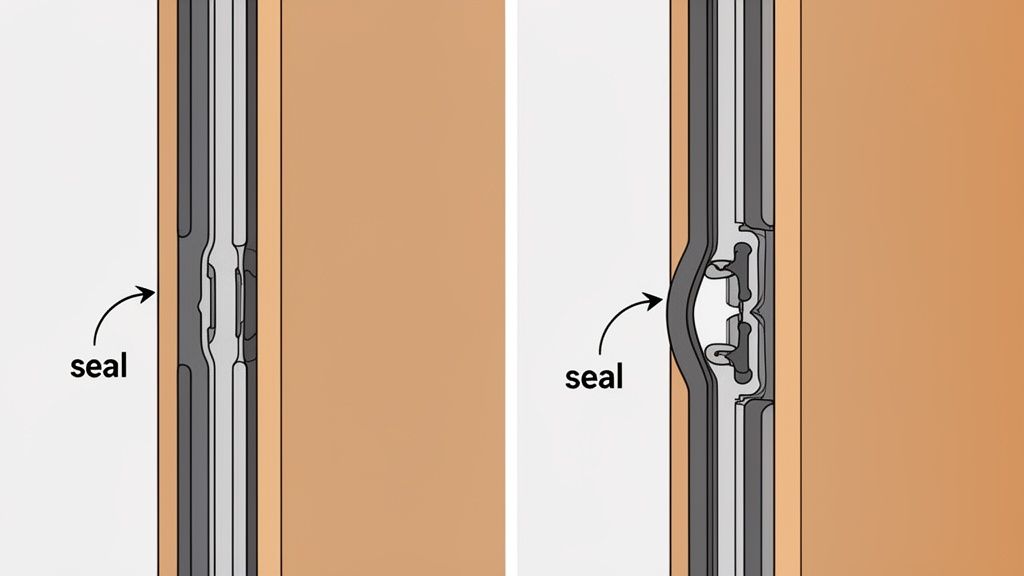
A critical component of any fire door assembly is the system of intumescent and smoke seals. These are not mere draught excluders; they are life-saving technologies designed to activate under specific conditions. An intumescent seal expands dramatically when exposed to heat, sealing the gap between the door and the frame to prevent the passage of fire. Smoke seals, often integrated with intumescent strips, create a barrier against toxic smoke and gases at ambient temperatures. This part of the fire door inspection checklist focuses on verifying their presence, condition, and correct installation.
The primary goal of this check is to ensure the seals can perform their function without obstruction or failure. This involves a close visual and tactile inspection to identify any damage, such as cracks, compression, or gaps, that could compromise their effectiveness. The seals must form a continuous, unbroken barrier around the door frame or leaf, as even a small gap can allow deadly smoke to penetrate a protected escape route.
What to Look For
A meticulous seal inspection is vital, especially in environments that can accelerate their degradation, such as high-traffic commercial areas or damp residential properties.
- Presence and Continuity: Verify that seals are fitted into the grooves of the door frame or the door leaf itself. They should be continuous along the top and both vertical sides of the door.
- Physical Damage: Look for any signs of wear and tear. Are the seals cracked, peeling, or painted over? Paint can inhibit the chemical reaction that causes intumescent seals to expand.
- Correct Installation: The seals should be seated correctly within their grooves, not protruding or recessed too far. They must be flush and secure, without any loose sections.
- Compression and Gaps: In high-traffic corridors, seals can become compressed or worn away from repeated use. Check for any areas where the seal is flattened, and ensure there are no gaps where the seals meet at the corners.
Key Insight: Smoke inhalation is the leading cause of death in fires, making effective smoke seals as important as the fire-resisting intumescent strips. A comprehensive approach is essential for occupant safety, a core principle detailed in this essential smoke control strategy guide.
Actionable Tips for Seal Assessment
To ensure your seal inspection is thorough and effective, follow these practical steps:
- Perform a Tactile Check: Gently run a fingernail or a soft, non-damaging tool along the length of the seal. This helps detect subtle damage, brittleness, or areas of compression that may not be obvious visually.
- Document with Photographs: Take close-up photos of the seals, especially in the corners and any areas showing wear. This provides a clear record for compliance checks and helps when sourcing correct replacements.
- Check for Obstructions: Ensure the grooves containing the seals are free from dust, debris, or old paint. Any obstruction can prevent the intumescent material from expanding correctly during a fire. Regular cleaning should be part of the maintenance schedule.
5. Door Hardware and Latching Mechanism Verification
The correct functioning of a fire door's hardware is non-negotiable, as these components ensure the door closes firmly and latches securely into its frame during a fire. This step in the fire door inspection checklist focuses on the hinges, handles, locks, and latching mechanisms. Each piece of hardware must be fire-rated, correctly installed, and in perfect working order to guarantee the door performs its life-saving role. A door that doesn't latch is effectively an open door to fire and smoke.
This inspection verifies that all ancillary hardware is not only present but also fully functional and appropriate for the specific fire door assembly. From the hinges that carry the door's weight to the latch that keeps it shut, every component is critical. Loose screws, worn-out mechanisms, or incorrect (non-fire-rated) hardware can lead to catastrophic failure, compromising the entire fire compartment.
What to Look For
A detailed hardware check is essential across all property types, from commercial offices where handles are changed for accessibility, to residential blocks where heavy use can cause wear and tear.
- Hinge Condition and Number: A fire door must have at least three CE-marked, fire-rated hinges. Check that all screws are present and tight, and that there are no signs of metal fatigue, wear, or corrosion.
- Secure Latching: The most critical function to test. When the door is closed gently, the latch bolt should engage fully and securely in the strike plate on the frame without needing to be forced. The door should be held firmly in place, with no rattling.
- Handle and Lock Operation: The door handle should operate smoothly, allowing the latch to retract fully without excessive force. If a lock is fitted, it must also be fire-rated and function correctly.
- Component Compatibility: All hardware, including any panic bars or additional locks, must be certified as compatible with the fire door. Mismatched or non-rated components will invalidate the door's certification.
Key Insight: Hardware is often the first point of failure due to daily use. A latch that doesn't fully engage or a loose hinge might seem minor, but in a fire, the pressure differences can force the door open. Every component must be CE-marked and fire-rated for the specific door assembly.
Actionable Tips for Hardware Assessment
To conduct an effective hardware and latching mechanism verification, follow these practical steps:
- Perform a Full Cycle Test: Open the door fully and allow it to close on its own (if a closer is fitted). Observe its movement, listening for any grinding or sticking sounds. Crucially, verify that it latches securely on every single test.
- Check for Tightness: Gently try to move the door leaf up and down and side to side when it is closed. There should be no significant movement or play in the hinges. Check that all visible screws on hinges, handles, and lock plates are tight.
- Document and Verify Markings: Look for the CE mark and fire rating stamp on the hinges and the latch mechanism body (often visible on the faceplate where the bolt emerges). Photograph these markings for your inspection records.
- Consult Manufacturer's Data: If you have access to the fire door's specification sheet, cross-reference the installed hardware with the manufacturer's approved list. This is particularly important after any replacements or repairs have been made.
6. Door Clearance, Alignment, and Gap Verification
Once the door frame and leaf are confirmed to be in good condition, the next critical stage of the fire door inspection checklist is to verify the clearance, alignment, and gaps. A fire door assembly must have precise, consistent gaps between the door leaf and the frame to function correctly during a fire. If the gaps are too large, they will allow smoke and flames to penetrate prematurely; if they are too small or inconsistent, the door may not close properly, rendering it useless.
This inspection involves meticulously measuring the gaps around the entire perimeter of the door. The goal is to ensure they fall within the strict tolerances specified by fire safety standards, typically just a few millimetres. Proper alignment is essential for ensuring the door hangs correctly, closes smoothly, and engages fully with the frame and its seals without binding or rubbing.
What to Look For
Verifying door gaps is a non-negotiable step, especially in buildings that experience settlement or heavy use, which can cause misalignment over time.
- Inconsistent Gaps: Visually scan the gap between the door and the frame. It should be uniform on the top and both sides. A tapered gap is a clear sign that the door has dropped or the frame has moved.
- Excessive Clearance: The gap between the sides and top of the door leaf and the frame should typically be no more than 4mm and no less than 2mm. A gap of 3mm is often cited as the ideal target. The gap at the bottom is often larger but depends on the presence and type of smoke seals.
- Binding or Sticking: As you operate the door, note any points where it rubs against the frame. This indicates a serious alignment issue that could prevent the door from latching correctly, particularly when under the control of a self-closing device.
- Sagging Door: Observe the top corner of the door on the handle side. If it appears lower than the hinge side, the door has likely sagged due to worn hinges or improper installation, a common issue in high-traffic commercial buildings or older rental properties.
Key Insight: The 3mm gap is not an arbitrary number; it is the optimal clearance required for intumescent seals to activate effectively. In a fire, the heat causes these seals to expand and fill the gap, creating a robust barrier against fire and smoke. If the gap is too wide, the seal may not be able to bridge it.
Actionable Tips for Gap Verification
A precise and methodical approach is needed to accurately assess door clearance.
- Use a Gap Gauge or Coin: For an accurate measurement, use a dedicated fire door gap gauge. As a quick reference, a £1 coin is approximately 3.15mm thick, making it a useful tool for a preliminary check of the top and side gaps.
- Measure at Multiple Points: Do not just measure in one spot. Check the gap at the top, middle, and bottom of both vertical sides of the door, as well as across the top. This helps identify warping in the door leaf or frame.
- Document with Photographs: Take close-up photos of your measurements, using the gauge or coin for scale. This provides clear, undeniable evidence of compliance or non-compliance for your fire safety records.
- Check for Frame Movement: Gently push and pull on the door frame itself. It should be completely rigid. Any movement suggests the fixings have failed, which will inevitably lead to alignment problems and compromise the entire assembly.
7. Fire Safety Signage, Labelling, Certification and Documentation
A fire door's physical condition is critical, but its official identification and the paperwork that supports it are equally vital for compliance. This step in the fire door inspection checklist involves verifying that the door assembly is correctly signed, labelled with its fire rating, and backed by a complete audit trail. This documentation proves the door meets specified safety standards and is essential for legal, insurance, and regulatory purposes.
The primary goal is to ensure that the door’s performance capabilities are clearly communicated and verifiable. This means checking for visible and legible signage (e.g., 'Fire Door Keep Shut'), confirming the presence of a certification mark indicating its rating (such as FD30 or FD60), and maintaining a file of all related documents. Without this evidence, a door’s effectiveness cannot be proven during a formal audit or after an incident.
What to Look For
Proper identification and documentation are non-negotiable, particularly for London property managers, landlords of HMOs, and commercial building operators who face stringent compliance checks.
- Correct Signage: Look for blue, circular "Fire Door Keep Shut" or "Fire Door Keep Locked" signs on both sides of the door, where applicable. The signs must be at an appropriate height (around 1.5 metres from the floor) and not be obscured, faded, or painted over.
- Certification Labels: Check the top edge or hinge side of the door leaf for a permanent label, plug, or stamp from the manufacturer or a third-party certification scheme (like BWF-Certifire). This mark confirms the door's fire-resistance rating and is a key indicator of its authenticity.
- Absence of Markings: A complete lack of signage or certification labels is a major red flag. It may indicate the door is not a genuine fire door or that its identity has been lost during maintenance or redecoration.
- Documentation Trail: For property managers and landlords, an organised file should exist containing manufacturer specifications, installation records, and a history of all maintenance and inspections. This is your proof of due diligence.
Key Insight: Documentation is not just administrative; it is a core component of your building's fire safety strategy. A robust paper trail is indispensable when demonstrating compliance for insurance purposes, local authority licensing, or as part of a comprehensive fire risk assessment. You can find out more by reading this guide on the legal requirements of a fire risk assessment.
Actionable Tips for Signage and Documentation
To ensure your doors are correctly identified and documented, implement these practical steps:
- Photograph All Labels and Signs: During your inspection, take clear, close-up photos of any certification marks and existing signage. Also, photograph the absence of these items. This visual evidence is crucial for your records and for briefing contractors on remedial works.
- Protect Signage During Redecoration: If a fire door is being painted or refurbished, make it a strict instruction that signage and certification labels are not to be removed or painted over. If signs must be temporarily removed, they must be replaced immediately afterwards with compliant equivalents.
- Establish a Centralised Fire Door Register: Create a simple spreadsheet or log for all fire doors on the property. Record each door's location, its fire rating (e.g., FD30), the date it was last inspected, and any actions taken. This register becomes the foundation of your compliance record.
- Digitise All Certificates: When a new fire door set is installed, immediately request all certification documents from the installer. Scan and save these digitally in a secure, backed-up folder, in addition to keeping physical copies. This protects against loss or damage to the original papers.
7-Point Fire Door Inspection Comparison
| Item | 🔄 Implementation complexity | ⚡ Resources & cost | ⭐ Expected outcome | 📊 Ideal use cases | 💡 Key advantages / Tips |
|---|---|---|---|---|---|
| Door Frame and Condition Assessment | Medium–High: visual/tactile checks; specialist for historic frames | Moderate–High: survey time, possible restoration or replacement | High: validates structural integrity and compliance | Heritage properties, renovations, kitchen/bath/loft conversions | Identifies early defects; photograph condition and consult conservation for period frames |
| Door Leaf, Vision Panels and Glazing – Integrity and Inspection | High: certification checks and glazing verification; hidden defects possible | High: fire-rated glazing and replacement can be costly; documentation needed | High when certified; non-compliant glazing severely reduces performance | HMOs, offices with vision panels, healthcare and commercial refurbishments | Verify FD labels and manufacturer docs; use light/tap tests and photograph defects |
| Door Closer and Self-Closing Mechanism Functionality | Low–Medium: functional testing and adjustment; some specialist calibration | Low–Medium: adjustment low cost; replacement £150–£400 typical | High: ensures reliable self‑closure and latching in an emergency | High-traffic commercial buildings, rental properties, offices | Test multiple closing cycles and angles; check for leaks and correct closer sizing |
| Intumescent Seals and Smoke Seals Inspection | Low: visual continuity and seating checks; careful removal for replacement | Low: replacement relatively inexpensive (£30–80); specialist fit recommended | High: critical for smoke containment and fire performance | Rental housing, kitchens, period properties with custom seals | Run fingernail along seals to detect compression; ensure seals continuous at corners |
| Door Hardware and Latching Mechanism Verification | Low–Medium: inspect hinges, locks, handles and fasteners | Low: component replacement straightforward; some fittings need pro installation | Medium–High: proper hardware ensures secure latching and usability | Offices, residential buildings, heritage sites balancing aesthetics and compliance | Test full operation and hinge security; tighten fasteners and confirm hardware matches spec |
| Door Clearance, Alignment, and Gap Verification | Low–Medium: simple measurements; may reveal need for frame works | Low–High: measurement inexpensive; re-alignment or frame repair can be significant | High: correct gaps prevent smoke/fire spread and ensure closure | Period properties with settlement, rentals, commercial buildings with thermal movement | Measure gaps at multiple points (typical 3–4mm sides/top); document and photograph measurements |
| Fire Safety Signage, Labelling, Certification and Documentation | Low for visual checks; High if re-certification or testing required | Low–Low for signage (£5–20); potentially high for missing certificates and retesting | High: essential for regulatory compliance, insurance and audit defence | Landlords, HMOs, commercial premises undergoing audits or handover | Check visibility and match labels to docs; maintain a central register and photograph evidence |
From Checklist to Action: Securing Your Property's Safety
You have now journeyed through the seven critical pillars of a comprehensive fire door inspection checklist. From the structural integrity of the door frame to the essential clarity of its safety signage, each element plays an indispensable role. This checklist is far more than a simple to-do list; it is a framework for proactive fire safety management, a tangible process for upholding your legal and moral responsibilities as a property owner, landlord, or business manager in the UK.
Completing the checklist is the vital first step. The true test of your commitment to safety, however, lies in the actions you take based on its findings. A fire door is a sophisticated, engineered system where every component, from the almost-invisible intumescent seal to the robust self-closing mechanism, must function in perfect harmony. A single point of failure, be it an excessive gap or a faulty latch, can render the entire assembly ineffective, catastrophically compromising its ability to contain smoke and fire. This is not a risk worth taking.
Bridging the Gap Between Inspection and Rectification
For those responsible for properties, especially the unique architectural landscape of London and the South East, this diligence is non-negotiable. Whether you manage a modern commercial office block or a portfolio of Victorian terraced houses, the principles of fire safety are universal, even if their application requires specialist knowledge.
Think of the process in three distinct phases:
- Systematic Inspection: Regularly and methodically work through the checklist. This creates a baseline understanding of your assets' condition.
- Diligent Documentation: Record every check, every measurement, and every finding. This record is your proof of compliance and your roadmap for necessary repairs.
- Decisive Action: Translate your findings into a clear plan. Minor adjustments, like tightening a loose hinge screw, might be straightforward. However, issues such as a warped door leaf, a damaged frame, non-compliant glazing, or a failing closer mechanism demand professional intervention.
Ignoring a "fail" on your checklist is tantamount to accepting a known vulnerability. It's a gamble with property, and more importantly, with people's lives. The Regulatory Reform (Fire Safety) Order 2005 places the onus squarely on the 'Responsible Person' to ensure fire safety measures are adequate and maintained. A documented checklist followed by prompt, professional remedial action is your strongest evidence of due diligence.
When to Escalate to Certified Professionals
Recognising the limits of your own expertise is a critical aspect of responsible property management. While routine visual checks can be carried out by a competent individual, rectifying significant faults is a job for certified experts. Engaging a BAFE-registered assessor for a formal inspection provides an accredited, third-party validation of your fire doors' condition, which can be invaluable for insurance and compliance purposes.
Similarly, for any repair, restoration, or replacement work, partnering with a qualified and insured contractor is essential. This ensures that the work not only fixes the immediate problem but also maintains the door's fire-resistance certification. A poorly executed repair can void a door's rating just as effectively as the original fault.
Ultimately, mastering the fire door inspection checklist is about cultivating a culture of safety. It's about shifting from a reactive mindset of fixing what's broken to a proactive one of preventing failure. It empowers you to protect your assets, ensure the well-being of your tenants and occupants, and build a reputation for uncompromising safety and compliance. This detailed, hands-on approach transforms a simple door into what it is designed to be: a life-saving barrier when every second counts.
When your inspection reveals the need for expert repairs, restoration, or a full replacement, trust the specialists who understand London's unique properties. All Well Property Services offers CHAS-qualified, fully insured services to ensure your fire doors are not just repaired, but are fully compliant and certified. Visit All Well Property Services to schedule a consultation and secure your property with confidence.